FILL OUT THE CONTACT FORM FOR A FREE 15-MINUTE CONSULTATION


A Major Breakthrough in Education: The "Teacherless Classroom" Experiment and the Sabrewing Programme in London
The UK’s first classroom without a teacher! A detailed look at David Game College’s innovative Sabrewing Programme, powered by AI & VR. We explore the adaptive learning model and the "Cyborg Teacher" revolution. Has the future of education officially begun?
Özge Zeytin Bildirici
6/10/20267 min read
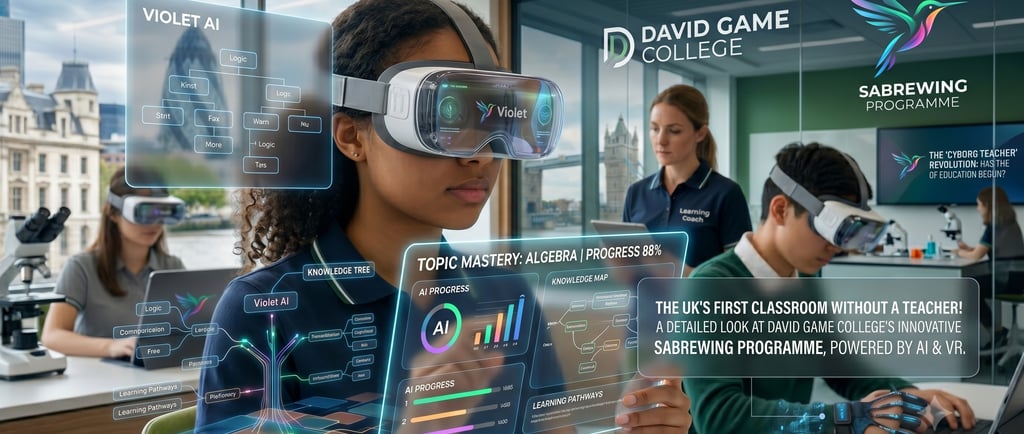
Educational technology (EdTech) has been a part of our lives for many years. From smart boards and tablets to distance learning platforms, we have always defined the boundaries of digitalization as a mere "support to the traditional classroom model." However, in the heart of London, David Game College, a well-established and prestigious private institution, has taken a bold step that shatters these boundaries and marks a true milestone in educational history: The Sabrewing Programme.
This programme completely phases out the "traditional teacher" model we all know—the one who lectures, writes on the whiteboard, and addresses the entire classroom at a single, fixed pace. So, what replaces it? AI-driven adaptive learning platforms, virtual reality (VR) technologies, learning coaches, and mentors.
But how exactly does this officially launched system by David Game College work? How is a student's day structured? And most importantly, can artificial intelligence truly replace a teacher? In this article, we dive deep into this fascinating new chapter of education, guided by the school's official programme details.
Where Does the Name 'Sabrewing' Come From? A Symbol of Flexibility and Agility
Before diving into the program's details, it is essential to look at the metaphor behind its name. The programme is named after the Sabrewing, a unique species of hummingbird. Hummingbirds are among the most extraordinary creatures in nature, celebrated for their exceptional agility, resilience, and adaptability. Most importantly, even when migrating over great distances, they do not fly in flocks; they fly completely solo.
David Game College did not choose this name by coincidence. The Sabrewing Programme aims to instill these exact qualities in its students: self-reliance, independent learning discipline, and the ability to adapt swiftly to a changing world. Furthermore, hummingbirds are the only bird species capable of flying in all directions—up, down, and backwards. From a pedagogical perspective, this beautifully symbolizes a student's freedom to "go back" and bridge their learning gaps when a topic isn't fully understood, allowing them to chart their own learning journey at their own pace.
The Core Structure of the Programme and a "Personalised" Curriculum
Sabrewing is designed as a one-year intensive pathway (with a two-year option available) for students preparing for their GCSEs (General Certificate of Secondary Education)—the secondary school qualification exams in the UK.
Within the scope of the programme, students take the following core academic subjects:
English Language
Mathematics
Biology
Chemistry
Physics
Geography
Computer Science
Students typically complete 5 GCSE subjects per year; however, this number can be adjusted—either increased or decreased—depending on the student's prior academic achievements, current level, and goals. The annual tuition fee for the programme is set at £27,000 incl. VAT (which includes all trips and activities, while excluding examination fees).
What Does a Day in the Life of a Sabrewing Student Look Like?
Although the school promises a completely digital world, the education takes place fully in person and on campus. Students arrive at the campus by 09:10 AM every weekday and follow a rigorous, two-part daily schedule until 4:30 PM:
1. Morning Sessions: Personalised Academic Study with AI
The morning hours are entirely academically focused. Students sit at their computers and work with the school's AI-powered personal tutor platform (featuring an AI assistant named Violet).
The system operates as follows: The AI explains a topic to the student and then conducts instant quizzes. If the student demonstrates 100% understanding and masters the topic, the system moves them forward to the next level. If there is a knowledge gap, the AI detects it immediately, pauses progress, and provides alternative content to bridge that specific gap. This ensures that no student in the classroom is held back or rushed by anyone else's pace. Those who understand quickly can accelerate, while those who struggle can review the material until they fully digest it, without any fear of falling behind.
2. Afternoon Sessions: Life Skills, Lab Work, and Socialisation
The answer to the question "Do students stare at screens all day?" lies right here: Absolutely not. David Game College dedicates the time saved by AI in the mornings entirely to human and social skills in the afternoons. Throughout the year, students participate in over 300 hours of practical laboratory work and life skills workshops.
What do these sessions include?
Resilience & Wellbeing: Protecting mental health and managing stress.
Public Speaking & Debate: Developing effective communication skills.
Teamwork & Leadership: Creating collaborative projects with peers.
Entrepreneurship & Financial Literacy: Preparation for the real world.
Technology & AI Literacy: Understanding the logic behind the technology they use.
Creative, Cognitive, and Physical Activities: Art, sports, and regular museum visits.
The New Roles in the Classroom: If There Is No Teacher, Who Is There?
Although the phrase "teacherless classroom" might sound dystopian, students are actually not alone in the classroom. The roles of adults have simply shifted in a radical way:
1. Learning Coaches
There is no teacher lecturing at the front of the room, but there are Learning Coaches who actively monitor students' study behaviors, focus spans, and AI learning data in real-time from their screens. These coaches step in on a "just-in-time" basis whenever a student gets stuck, experiences a drop in motivation, or loses focus, providing immediate and targeted support.
2. Weekly Mentoring
Students meet with their personal mentors at least once a week. In these sessions, academic goals are reviewed, personal development processes are analyzed, and psychological guidance is provided to boost the student's self-confidence and momentum.
3. Subject Specialist Teachers
Traditional teachers have not been entirely eliminated from the school; rather, their roles have been highly refined. Subject-specialist teachers lead the afternoon laboratory experiments, deliver revision classes as exam periods approach, grade mock exams to provide detailed feedback, and offer crucial one-to-one academic support during critical periods.
The Advantages Provided to Students by the Sabrewing Programme
According to the data shared on David Game College’s website, this innovative model offers students clear and distinct advantages compared to traditional education:
Accelerated Learning: Students save a tremendous amount of time by quickly passing over topics they already know, allowing them to focus strictly on the areas where they actually need to learn.
Improved Subject Knowledge: Thanks to the "topic-by-topic mastery" model, no new information is built upon shaky foundations. Every single step forward is taken only when the previous one has been completely and thoroughly learned.
Confidence and Motivation: As students see themselves progressing through the AI interface and mastering topics, their sense of achievement and self-belief naturally increases.
Independence and Work Ethic: Because students learn to manage their own learning processes without someone constantly dictating what to do, they develop a strong work ethic and independence—qualities that are highly crucial for future university and professional life.
Debates in the Educational World and a Pedagogical Evaluation
This move by David Game College has ignited a major debate within educational circles. While one camp views this model as the "democratization and individualization of education," the other expresses deep concern that human connections will be weakened.
However, a closer look at the design of the Sabrewing Programme reveals that the school anticipated these criticisms and established a highly balanced, hybrid model. By entrusting cognitive performance and data analysis to artificial intelligence in the mornings, and focusing on the values that make humans "human" (such as empathy, debate, teamwork, and art) in the afternoons, the school has created a brilliant "Cyborg Teacher / Hybrid Classroom" ecosystem. Furthermore, to ensure students do not feel isolated from the school community, they are actively encouraged to join clubs, share lunch breaks, and participate in social activities alongside students from the traditional classrooms.
Conclusion: The Future of Education or a Passing Trend?
Through the Sabrewing Programme, David Game College automates the "information transfer" phase of education while simultaneously deepening the "human development" aspect. In this regard, Sabrewing is not a project that eliminates teachers; on the contrary, it is a visionary initiative that elevates them from being figures who merely repeat raw information to true guides and mentors who actively touch a student's life.
If your child is suffocating at the fixed pace of traditional classrooms—either getting bored because they move too fast or giving up because they fall behind—this AI-backed model flourishing in London might just be the exact "personalized" educational revolution we have been searching for.
As an educator closely following the integration of AI in education, I can confidently say that this bold step taken by David Game College is the first working prototype of the very structure all schools will eventually have to transform into in the future.
🧠 Frequently Asked Questions (FAQ)
1. What is the David Game College Sabrewing Programme?
Answer: The Sabrewing Programme is the UK's first AI-powered and traditionally "teacherless" GCSE and A Level pathway, launched by David Game College in London. It combines personalized, AI-driven academic learning in the mornings with a robust life-skills and laboratory programme in the afternoons.
2. Are there really no adults in the "teacherless classroom" model?
Answer: No, students are not left entirely on their own. While there is no traditional teacher lecturing at the front of the class, dedicated Learning Coaches who actively monitor student learning data in real-time and Mentors who track weekly personal progress are always present in the classroom.
3. Which subjects are offered in the Sabrewing Programme?
Answer: Within the GCSE curriculum, students can take the following 7 core subjects: English Language, Mathematics, Biology, Chemistry, Physics, Geography, and Computer Science.
4. Do students spend the entire day looking at computer screens or wearing VR headsets?
Answer: No. Screen-based and AI-powered (Violet AI) adaptive learning is strictly limited to the morning sessions for academic knowledge acquisition. In the afternoon sessions, screens are turned off, and students engage in fully face-to-face, interactive activities such as debate, public speaking, teamwork, sports, arts, and practical lab work.
5. What is AI-powered adaptive learning?
Answer: Adaptive learning is an educational model where AI analyzes a student's responses to identify their strengths, weaknesses, and knowledge gaps, completely personalizing the curriculum to that specific student's pace. The system does not advance a student to a new topic until they have achieved full mastery of the current one.
6. Can Sabrewing students socialise with other students at the college?
Answer: Yes. Students on the Sabrewing Programme remain an integral part of the wider David Game College community. They interact with other students during lunch breaks, before and after classes, and are fully welcome to join the college's trips, clubs, and shared social events.