FILL OUT THE CONTACT FORM FOR A FREE 15-MINUTE CONSULTATION



Digital Citizenship in the Age of AI
Why is digital citizenship critical in AI-supported educational environments? A comprehensive guide for teachers supported by practical suggestions, classroom activities, and resources.
Özge Zeytin Bildirici
12/2/20257 min read
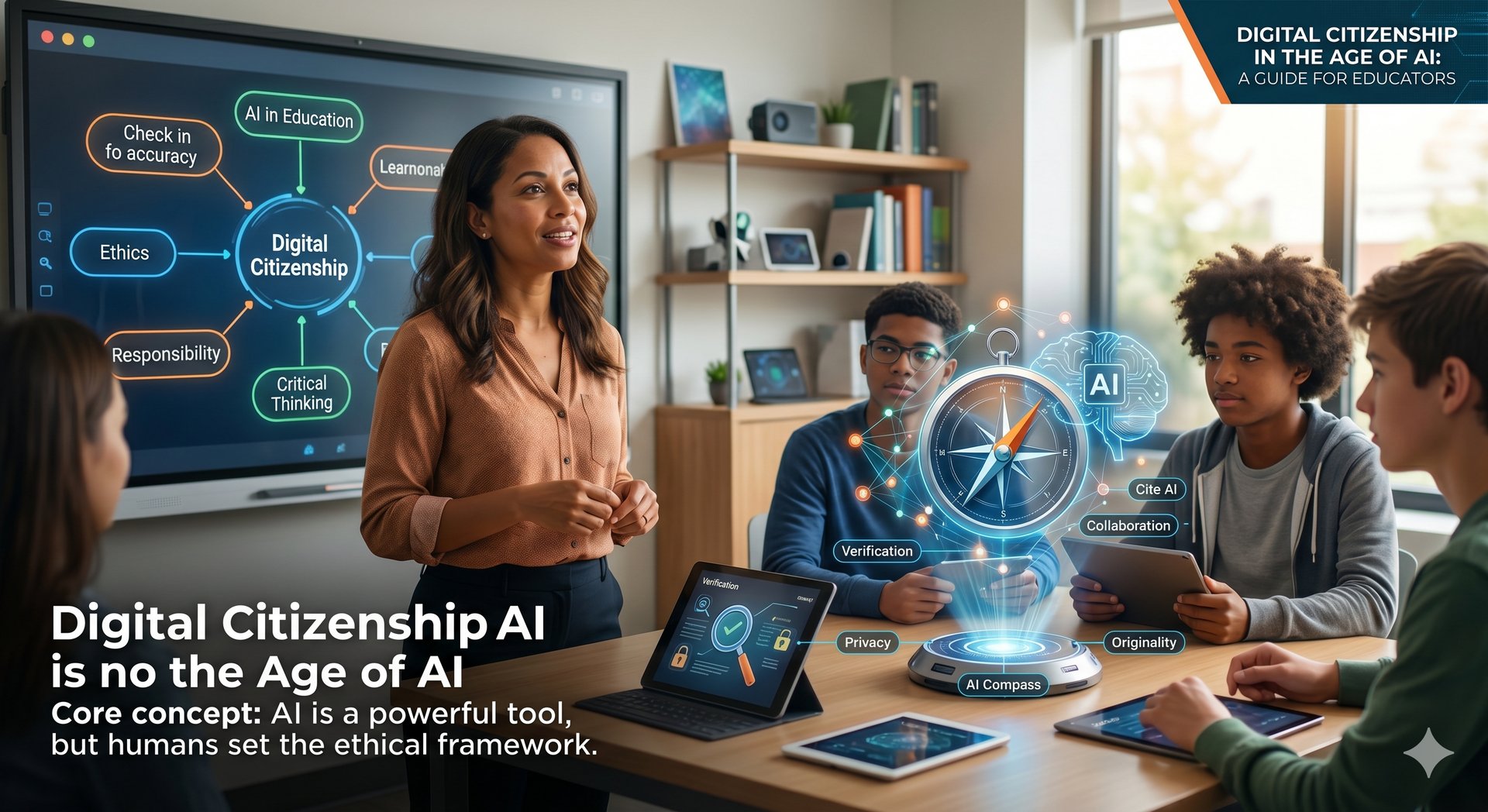
It wasn't so long ago—just two years, in fact—that the most heated debate in the teachers' lounge revolved around vibrating cell phones in the middle of a lesson. While we were caught in the dilemma of "should we collect phones in a box or ban them entirely?", we woke up one morning to find not just a device, but a massive "intellect" that some feared would push students toward laziness. Artificial Intelligence has forced us to revisit the core notions of the educational world.
Today, we have reached a point where students use AI as if they have personal assistants, and teachers lighten the burden of evaluating hundreds of pages in mere seconds. Yet, in the midst of this digital revolution, a question as old as technology itself—but just as fresh—echoes:
How will we protect our rights, responsibilities, and those precious ethical boundaries in this new world?
The concept of "Digital Citizenship" has become our compass, pointing the way through this very chaos.
Why is Digital Citizenship Essential?
The spread of AI tools in education has split our classrooms in two. On one side are those who see these tools as modern cheating devices used only for "doing homework the easy way." On the other side are those who use AI as a creative production partner—a brainstorming buddy. There is only one competency that bridges the massive gap between these two groups: Digital Citizenship Skills.
In the AI era, being a good digital citizen is not just about being able to access the internet; it is about weighing what the internet offers you and what you take from it. In this context, three critical points emerge:
A New Definition of Academic Integrity: The difference between presenting an AI-generated answer as one’s "own production" and being inspired by that answer to build one’s own interpretation will define the honest individuals of the future.
The Data Privacy Deadlock: The smarter an algorithm is, the hungrier it is for data. It is now a vital necessity for our students to learn which personal information is "private" and should never be entrusted to an AI.
Accuracy of Information and the "Hallucination" Risk: AI does not always tell the truth; sometimes it presents completely fabricated information in a very confident tone. A good digital citizen will be a "information detective" who passes every piece of information that falls onto their screen through a critical filter.
The Great Dilemma of Schools:
To Ban or To Frame?
The first reflex of many educational institutions was a fear-based protectionism: banning AI tools entirely. Students were blocked from accessing these AI sites and platforms via school internet. But since when have bans been a solution? A student can access a platform blocked on the school Wi-Fi via their own mobile data plan in seconds. Banning is never a solution; it only creates an "invisible space" for the student—unsupervised, unguided, and ethically orphaned.
The method I have observed and advocated for years in the field is: Framing instead of banning.
When you, as an educator, draw these boundaries clearly for your students, you are actually giving them the greatest freedom:
Clarity: In which projects is AI use strictly prohibited? (e.g., core language skill assessments)
Collaboration: In which activities is AI use encouraged as a "research partner"?
Transparency: When AI is used, how should it be declared? (Cultivating a culture of citation)
Practical Application Suggestions for the Classroom and Home
Abstract principles remain up in the air for students. Therefore, we must make the process concrete:
Ethical Scenario Discussions: Open a discussion in class: "Is it ethical if a student writes an entire essay with AI, but the ideas belong to them?" Don't give the right answer; let them find it.
Cross-Referencing Sources: Ask students to compare an answer given by AI with books in the library or reliable academic sites. The differences are the greatest learning moments.
Reflective Journals: Add a small note area at the end of assignments: "How did I benefit from AI while preparing this homework? Where did I stop?"
Traditional vs. AI-Supported
Digital Citizenship
The concept of digital citizenship has changed alongside the speed of technology. The clearest map we have to understand this change is to compare traditional methods with the new AI-supported world. Let’s examine this transformation across four main axes:
Feature Traditional Digital Citizenship Digital Citizenship in the AI Era
Source of Information Search engines and websites Generative algorithms and chatbots
Integrity Plagiarism control "Prompt" ethics and AI usage declaration
Security Password protection and cyberbullying Data privacy and algorithmic manipulation
Critical Thinking Distinguishing ads and fake news Spotting AI hallucinations and bias
1. Source of Information: From Searching to Generating
In traditional digital citizenship, our main skill was "finding." We used search engines like Google and tried to select the right one from millions of websites. Information was fixed, like a book on a library shelf. We were simply good researchers.
Today, in the Age of Artificial Intelligence, information is no longer static; it is dynamic and generative. A student no longer "reaches" information; they "synthesize" it in seconds through chatbots and generative algorithms. This situation transforms the responsibility of the digital citizen from a librarian to a curator. The issue is no longer where the information is, but how the algorithm creating it has blended it with which data.
2. The New Test of Integrity: From Copying to Declaration
In the past, the only nightmare that came to mind regarding academic integrity was "plagiarism." Copying and pasting a text was a crime with clear ethical boundaries and was easy to catch. Teachers would hunt for this theft with tools like "Turnitin."
However, with AI, integrity has ceased to be black and white; the gray areas have expanded. We are now faced with "Prompt Ethics" and "Usage Declaration." Today, a good digital citizen does not claim AI output as their own. They use it as a "spark of an idea" and explain this process honestly. Being able to say, "I built the skeleton of this text with AI, but I enriched the analysis with my own experiences," has become the greatest virtue of the new world.
3. Security: From Passwords to Algorithms
In the traditional world, security was provided by passwords. Setting a strong password, standing tall against cyberbullying, and keeping our personal information private was enough. Our focus was on "human attackers."
In the age of AI, security has evolved into the control of data. We are no longer just talking about our passwords, but the privacy of our data and algorithmic manipulation. AI models are data-hungry; every personal detail we give them can be included in the system. A digital citizen must now think about how an algorithm can profile them and how this data might be used against them in the future.
4. Critical Thinking: From Fake News to "Hallucinations"
In the past, critical thinking meant looking at the source of a news story and asking, "Is this real or is it clickbait?" Fighting fake news was the core skill.
Now, we face the risk of AI "hallucinating." AI sometimes generates completely fabricated information in such a confident tone that even adults can believe it. Furthermore, "biases" hidden within algorithms can cause us to see the world one-dimensionally. A modern digital citizen must have the ability to see the answer on their screen not as an "absolute truth," but as a "claim that needs to be verified."
The Three Main Dimensions of Digital Citizenship
When discussing AI in education, we must address digital citizenship in three main dimensions. These dimensions are tightly linked; the absence of one causes the system to collapse.
AI Literacy: Not "What did AI say?", but "What do I think?" Digital literacy is giving way to AI literacy. This means understanding what a tool can do as much as what it cannot. The moment a student realizes that AI-generated content can be biased, incomplete, or incorrect, they move from being a "user" to a "manager."
Ethics and Integrity: Shortcut or Development? AI can facilitate cheating just as much as it can propel original production to massive proportions. The deciding factor here is the school culture. Using AI to summarize a text, create a skeleton, or gain different perspectives is ethical production. We should see this not as a "shortcut," but as a "stepping stone."
Security and Leaving a Trace: Digital Footprint AI systems improve with the data they are fed. The biggest duty of teachers and parents is to explain the permanence of "digital footprints" to students. Data such as real names, addresses, and ID numbers should not be entered into these systems; this is the most fundamental rule for the secure internet of the future.
Conclusion: A New Equation for a Strong Future
Artificial intelligence is neither a miracle nor a disaster in education; it is simply a very powerful lever. What will turn this lever in the right direction is our culture of digital citizenship. When our students start asking "How can I use this tool most responsibly?" instead of "Can I use this tool?", we will have initiated the real transformation in education.
If you want to be part of this transformation as an educator or parent, we must remember that:
Technology + Ethics + Critical Thinking = Strong Digital Citizen.
Frequently Asked Questions
1. Does the use of AI completely end academic integrity?
No, on the contrary, it deepens the definition of academic integrity. The key is to make the process transparent. When a student declares that they used AI as a tool and adds their own analysis on top of it, this is honest and ethical academic production.
2. Do AI tools banned in schools protect the student?
Unfortunately, they do not. Instead, they leave the student vulnerable and unguided against the risks of these tools (misinformation, data leaks). Protection is achieved through conscious use education, not through bans.
3. How can we tell if a student had AI do their homework?
Sudden changes in writing style, very specific information without a source, or complex sentence structures not normally used by the student can be clues. However, the best way is to talk to the student about their assignment—a sort of oral interview to ensure they understand their work.
4. Why is it dangerous to give personal data to AI?
Most AI models store the entered data in a pool to train the system. A shared address or private information could become part of an answer provided to another user in the future.
5. At what age should digital citizenship education begin?
Digital citizenship education should start at every moment contact with the internet begins. However, ethical discussions specifically regarding AI should be deepened starting from the middle school level, where abstract thinking skills develop.