FILL OUT THE CONTACT FORM FOR A FREE 15-MINUTE CONSULTATION



Has AI Guidance Failed in Schools? The Great Call from Students
85% of students are left completely alone in the AI ocean! In light of Oxford University Press’s June 2026 report "Navigating AI in Education," we explore the institutional guidance gap and the massive innovation call young people are making to schools. To avoid failing the class, let's talk about digital pedagogy, not bans.
Özge Zeytin Bildirici
6/22/20267 min read
📝 Editor’s Note / This is a Blog Series
Dear Readers,
In the world of educational technology and digital pedagogy, I deeply value discussing the role of artificial intelligence not just as a technical tool, but through a vision that places the human, the teacher, and the student at the very center. Right at this juncture, Oxford University Press (OUP) published a highly striking and up-to-date research report in June 2026: "Navigating AI in Education."
This comprehensive report sheds light on the actual place of AI in classrooms, the ethical confusion experienced by young students, the lack of guidance in schools, and, most importantly, the irreplaceable human and emotional bond that teachers provide.
Rather than cramming all the valuable data, statistics, and pedagogical insights from the report into a single post, I have prepared a special 6-part blog series to examine each dimension in depth. Welcome to the third part of this series, where we treat AI not as a threat or a mere disruptor, but as a partner reshaping the architecture of education!
Part 1: Is Using AI for Homework Cheating? The "Gray Area" Dilemma of Youth
Part 2: AI Enters the Classroom, But Teachers Are Irreplaceable: Why Do Youth Want "Humans"?
Part 3: Has AI Guidance Failed in Schools? The Great Call from Students (You are here)
Part 4: Excitement, Not Fear: What Does the Younger Generation Expect from an AI-Powered Future of Education?
Part 5: The Great Misconception About AI: Young People Are Not as "Shortcut-Oriented" as Thought
Part 6: The Oxford Guide for Teachers: How to Correctly Manage AI Potential in the Classroom
Enjoy the read! Please remember to share your comments, your own classroom experiences, and your learning journeys throughout this series!
When discussing the role of AI in education, we touched upon two vital points in the first two chapters. We examined the massive ethical "gray area" youth experience while doing homework, and analyzed why students insistently seek a "human teacher" connection no matter how advanced AI becomes. However, there is another highly critical, structural, and institutional side to the coin: How ready are schools for this massive technological wave?
Oxford University Press (OUP), one of the most deep-rooted and respected institutions in the educational world, seeks the answer to this very question in its research report published in June 2026, "Navigating AI in Education." The results put forward by the report act as an alarm bell for the educational system: Schools are unfortunately failing when it comes to AI guidance, and students are making a massive call against this isolation.
In light of the striking data from the report, let's explore exactly what students expect from schools and policymakers, and how this institutional vacuum can be filled.
The Numbers Speak:
Great Institutional Isolation
Having smart boards in classrooms, students walking around with tablets, or schools owning computer labs does not mean those institutions are "AI-ready." Even the generation that adapts to technology the fastest needs an institutional compass regarding the ethical, safe, and efficient use of this technology.
However, the following statistic from the Oxford University Press 2026 report shows that educational managers and policymakers need to stop and think deeply:
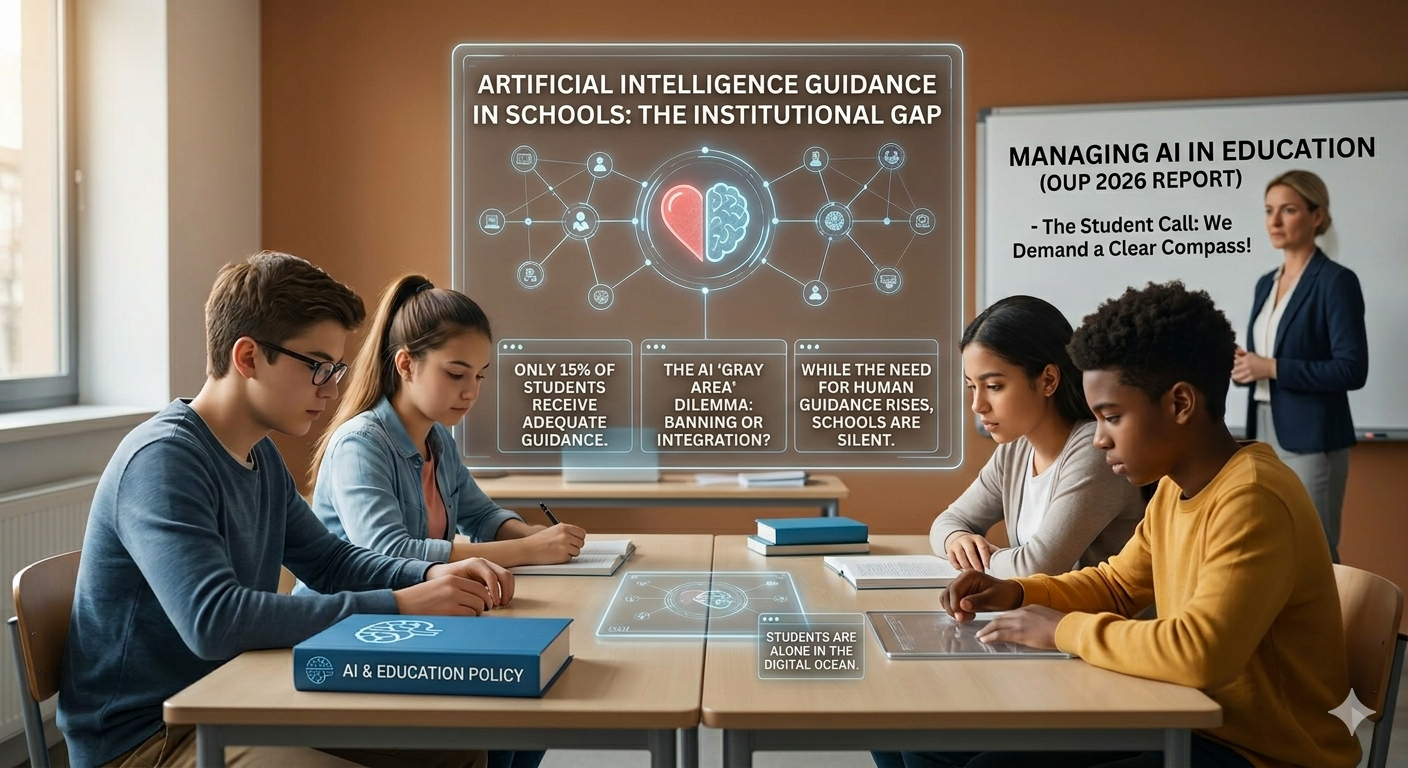
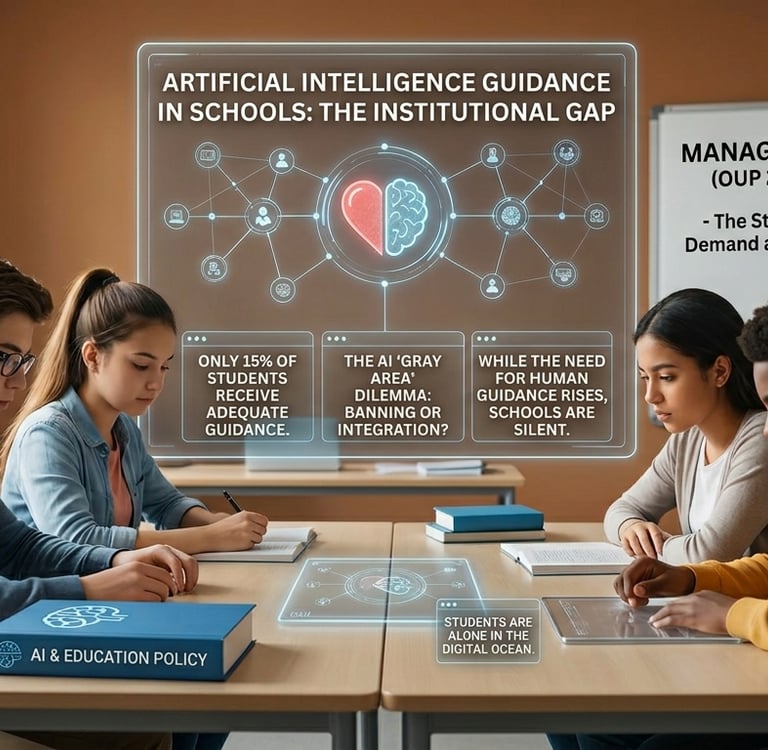
Only 15% of the students participating in the research state that they receive sufficient guidance, training, and support from their schools on how to use AI tools correctly and ethically.
This data reveals a striking contradiction: Almost all young people actively use AI in their daily lives, assignments, and research processes. Yet, the support they receive from schools regarding how this usage should look is almost non-existent. 85% of students are left completely alone in this digital ocean. They are trying to find their way through trial and error, word-of-mouth information, or what they see on social media.
Students Expect a Compass, Not a Ban
What was the first reflex of many school administrations when facing AI? Let's remember: Blocking websites like ChatGPT on school networks, directly sending students who use AI to disciplinary boards, or trying to pull assignments completely back to the pen-and-paper era.
However, banning is not a strategy; it merely covers up the problem. The younger generation is not running away from technology; on the contrary, they want schools to catch up with this speed. According to the OUP report, 77% of students demand that their teachers and schools actively integrate AI into education to support lessons and enrich learning.
Students are essentially making this massive call to schools:
"We use these tools, and we will have to use them in the future business world as well. Do not ban this for us; teach us how we can use it correctly, honestly, and creatively."
A lack of institutional guidance does not stop students from using AI; it merely degrades their purpose of use. A student who does not receive correct guidance starts viewing AI simply as a "homework copying machine." On the other hand, a properly guided student can position it as a "sparring partner" that develops their critical thinking.
What Risks Does the Lack of Guidance in Schools Create?
The silence of schools and the vacuum in the field of guidance pave the way for three major dangers in the educational ecosystem:
1. The Digital Divide and Opportunity Gap
When AI literacy education is not provided systematically by the school, students' socio-economic backgrounds come into play. Students who have families with this awareness at home or who can access private consulting learn to use AI as a development tool. Meanwhile, students who lack these opportunities remain stuck in the most primitive and shortcut-oriented dimension of the technology. This undermines equal opportunity in education.
2. Academic Insecurity and a Culture of Fear
Because schools fail to set a clear policy, students live with a constant "fear of getting caught." Even when they develop an original idea of their own using AI, they think they will be punished, which leads to intense academic anxiety. It is impossible for creativity and innovation to emerge from an educational environment built on fear.
3. Information Misinformation (Hallucinations)
AI models have a tendency to "hallucinate"—meaning they present incorrect information confidently as if it were true. Unless schools teach students how to verify AI outputs and conduct source analytics, young people face the risk of accepting this incorrect information as absolute truth.
What Should Schools Do to Avoid Failing the Class?
This clear diagnosis from the Oxford report invites the educational system into an urgent healing process. To avoid failing the class in "AI Literacy," schools must take these concrete steps:
Create an Institutional AI Policy: Every school must provide a clear guide to students, teachers, and parents at the beginning of the term. Questions like "In which situations and within what boundaries can we use AI? What level constitutes a violation of academic integrity?" must be answered in writing, leaving no room for gray areas.
Enhance Teachers' Digital Pedagogy Competence and Adaptation: Teachers are the ones who will guide students in this new era. However, our educators must not be left isolated in this rapid transformation process either. School administrations must take steps to prevent teachers from viewing AI as a threat to their profession. Continuous and high-quality Professional Development (PD) programs should be organized to show how this technology can be used as a powerful pedagogical assistant in lesson planning, material development, and assessment. The goal is to accelerate teachers' adaptation to technological tools and strengthen their expertise in digital pedagogy.
Add "AI Literacy" Lessons to the Curriculum: Using AI is not just a technical skill (coding, prompt writing). The ethical dimension of this work, data privacy, copyrights, and critical thinking processes must become an organic part of the curriculum. Students must gain the skill of "asking the right questions" (prompt engineering) and "filtering the outcome through a critical lens."
Final Words: Schools Must Provide the Compass of the Future
The June 2026 report by Oxford University Press holds a very clear mirror up to the educational world. The AI train left the station long ago and is moving incredibly fast. School administrations and educational policymakers face two choices: They will either ignore this train and get left behind on the tracks, or they will become leaders who guide the train and draw a safe route for their students on this journey.
The great call from students is not a cry for help; it is a highly mature invitation for innovation made to the educational system. Young people are aware of the power of technology, but they need the protective umbrella of human wisdom and institutional guidance. Schools must stop turning a deaf ear to this call and transform classrooms into spaces where AI is not feared, but learned with confidence.
In the next part of our blog series, we will examine the immense energy young people feel toward AI. Contrary to popular belief, are they afraid, or are they excited? See you in Part 4: "Excitement, Not Fear: What Does the Younger Generation Expect from an AI-Powered Future of Education?" Let's meet in the comments: What do you think is the biggest wrong step schools have taken regarding artificial intelligence?
❓ Frequently Asked Questions (FAQ)
1. According to the Oxford University Press June 2026 report, what is the state of AI guidance in schools?
According to the report, schools face a severe lack of AI guidance. Only 15% of the surveyed students state that they receive sufficient training and guidance from their schools on the correct and ethical use of AI tools.
2. What do students expect from schools and teachers regarding AI?
77% of students want school administrations and teachers to actively integrate AI tools into education to support lessons and enrich learning processes, rather than banning them. Young people demand guidance, not bans.
3. Why is banning the use of AI in schools not a solution?
Bans do not stop students from using AI; they merely make this usage hidden. Hidden use completely eliminates pedagogical oversight and teacher guidance, leading students to use AI through unethical, shortcut-oriented methods, while triggering academic anxiety.
4. What should AI Literacy education encompass?
A proper AI literacy education should not just include technical knowledge like prompt writing. In addition, it must cover academic integrity and ethical rules, data privacy, copyrights, verifying the accuracy of AI outputs (combating misinformation), and critical thinking skills.
5. What concrete steps should school administrators take to prevent AI chaos in classrooms?
School administrators must urgently create a transparent and clear "Institutional AI Use Policy" to define the boundaries for both students and teachers. Furthermore, they should organize professional development training to strengthen teachers' digital pedagogy skills and include AI ethics topics in the curriculum.