FILL OUT THE CONTACT FORM FOR A FREE 15-MINUTE CONSULTATION


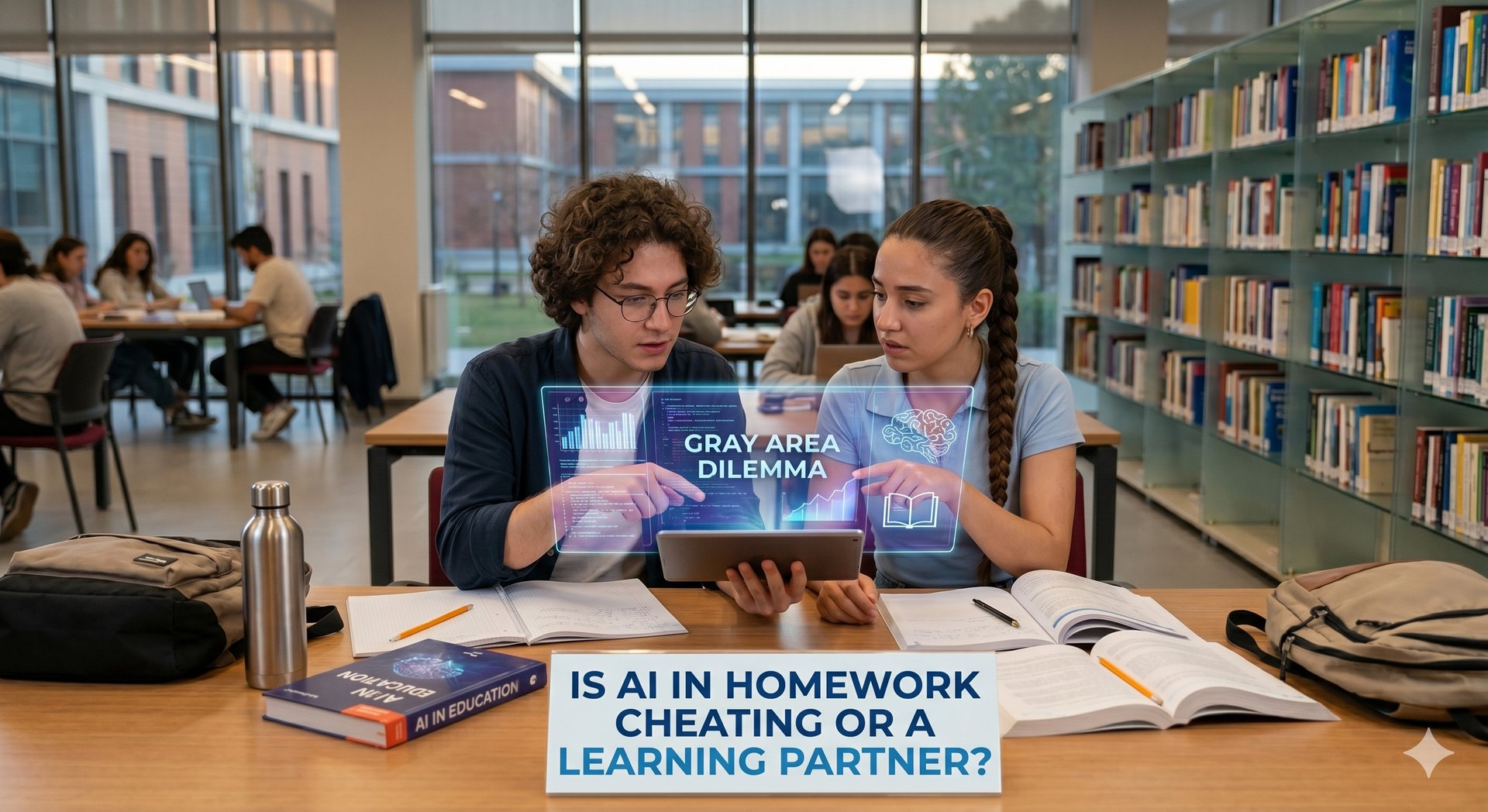
Is Using AI for Homework Cheating? The "Gray Area" Dilemma of Youth
Is AI in homework a tool for cheating, or is it a next-generation learning partner? In light of Oxford University Press’s June 2026 report "Navigating AI in Education," we dive into the ethical confusion students face and the massive "gray area" in education. Discover process-oriented pedagogy and solutions to rebuild digital integrity in classrooms.
Özge Zeytin Bildirici
6/15/20267 min read
Editor’s Note:
Dear Readers,
In the world of educational technology and digital pedagogy, I deeply value discussing the role of artificial intelligence not just as a technical tool. Instead, we must focus on a vision that places the human, the teacher, and the student at the very center. Right at this juncture, Oxford University Press (OUP) recently published a highly striking and up-to-date research report in June 2026: "Navigating AI in Education."
This comprehensive report sheds light on the actual place of AI in classrooms. It highlights the ethical confusion experienced by young students, the lack of guidance in schools, and, most importantly, the irreplaceable human and emotional bond that teachers provide.
Rather than cramming all the valuable data, statistics, and pedagogical insights from the report into a single post, I have prepared a special 6-part blog series to examine each dimension in depth. We will not look at AI as a threat or a mere disruptor. Instead, we will explore it as a partner reshaping the architecture of education. Welcome to part one!
Part 1: Is Using AI for Homework Cheating? The "Gray Area" Dilemma of Youth (You are here)
Part 2: AI Enters the Classroom, But Teachers Are Irreplaceable: Why Do Youth Want "Humans"?
Part 3: Has AI Guidance Failed in Schools? The Great Call from Students
Part 4: Excitement, Not Fear: What Does the Younger Generation Expect from an AI-Powered Future of Education?
Part 5: The Great Misconception About AI: Young People Are Not as "Shortcut-Oriented" as Thought
Part 6: The Oxford Guide for Teachers: How to Correctly Manage AI Potential in the Classroom
Enjoy the read! Please share your comments, your own classroom experiences, and your learning journeys throughout this series.
For a long time in digital pedagogy, we have been discussing the technical capacity of AI. We talk about how fast language models develop and which tools solve which problems. However, while trying to keep up with the speed of technology, we sometimes miss a critical focus: How students feel and how they make sense of this process.
Oxford University Press (OUP), one of the most established institutions in education, shed light on this exact topic with its June 2026 research report: "Navigating AI in Education." When examining the relationship of young people around the world with AI, the report brings a clear reality to the table: Young people use AI, but they face a serious ethical dilemma and confusion while doing so.
Let’s explore that "gray area" in the world of youth through the data from this report.
The Great Confusion: Where Does the Line Begin?
Today, the biggest problem we face in classrooms is not that students use AI. The real issue is that they do not know how and how much they can use it before it becomes an "offense." The OUP report highlights this search for clarity with striking numbers.
According to the research, 44% of surveyed students think that having AI write an entire assignment is definitely cheating. So far, everything is clear and expected. However, when we look at the other side of the coin, things get gray:
Around 20% of students view simply asking AI for a small hint or using it to develop an idea as a form of "cheating."
The remaining large majority is simply not sure where they should stand.
This data tells us something vital: The younger generation is not a "lazy" group trying to sabotage the system or look for easy ways out. On the contrary, they want to be honest. They try to balance their own effort with technological support. However, an educational architecture that defines where this line begins and ends does not yet exist. Because boundaries are unclear, students carry a sense of guilt every time they ask ChatGPT or another language model a question for their homework.
The Traditional Definition of Homework is Dead
In the pre-AI era, academic integrity rules were simple: "Do not copy your friend's homework, and do not copy-paste text from the internet without a citation." Plagiarism checkers worked with this exact logic. If two texts matched, we called it cheating.
Today, however, AI generates original, completely unique texts that have never been written before. When a student has AI generate a draft, this is technically not "stolen from another source." This is why traditional definitions of plagiarism and academic integrity fail to meet the realities of today's education.
Young people are looking for answers to these questions:
Is it okay to use AI just to check grammar mistakes?
Is it ethical to ask AI to create an outline for an assignment?
Is it against academic honesty to have AI summarize a long article during research?
The fact that these answers change from school to school, or even from teacher to teacher within the same school, deepens the "gray area" dilemma. An approach that one teacher sees as a "great research method" can be labeled as "laziness and cheating" by another.
How the "Gray Area" Affects Students
This uncertain environment without clear rules triggers two main negative outcomes for students:
1. Academic Anxiety and Distrust
Even when students enrich their own ideas with AI, they fear getting caught or punished. This fear prevents them from seeing technology as a creative learning partner. Technology stops being a tool for growth and turns into an object of fear.
2. Hidden Use and Alienation
When rules are too strict and prohibitive, students do not stop using AI; they just start doing it secretly. Hidden use completely removes pedagogical guidance. Teachers cannot give proper feedback because they cannot see how the student used AI in the process. As a result, students alienate themselves from their own learning journeys.
What is the Solution? Manage the Process, Don't Ban the Tool
How can we clarify this gray area as educators, school leaders, and parents? The analysis of the Oxford report and the principles of digital pedagogy show us a clear direction: We must talk about process management, not bans.
The educational model where we only grade the "final product" (the final text handed in) is losing its validity. Detecting how much of that final product belongs to the student and how much belongs to AI is becoming harder every day. We must shift our focus from product to process.
To achieve this, we can take the following steps:
Transparent AI Citation: Instead of banning AI completely, we can teach students to openly declare where and how they used it. For example, a student should be able to add this note to their work: "The main ideas and arguments of this assignment belong to me. However, [AI Tool] was used to organize the flow of the introduction and to filter research sources." This is the next-generation definition of academic integrity.
Process-Oriented Assignment Design: We must stop viewing homework as texts merely written at home and brought to class. In-class discussions, oral presentations, learning diaries kept during preparation, and early brainstorming stages should all be part of the evaluation. Even if a student uses AI, they should show how they processed that information in the classroom environment.
Setting Common Standards: School administrations urgently need to create clear "AI Use Policies" that protect both teachers and students. What level of use is acceptable and what constitutes an academic violation should be listed clearly, leaving no room for gray zones.
Final Thoughts: A Technological Tool, A Human Decision
AI is radically changing the architecture of education. However, the most valuable reminder from Oxford University Press’s 2026 report is that human psychology and ethical values still sit at the center of this change.
Young people do not run away from technology; they grow up with it. What they truly need is a compass to find their way in this massive new digital ocean. If we, as educators, fail to provide that compass—meaning clear guidance, ethical boundaries, and process-oriented pedagogy—we leave them alone and insecure in this gray area.
Using AI for homework is not an act of cheating on its own. Cheating is replacing our own minds, critical thinking, and unique output with AI. Bringing this distinction to our students is the most urgent duty of the modern educational world.
In the next part of our series, we will examine why young people still insist on having a "human teacher" despite the rise of AI. We will explore the irreplaceable emotional bonds and the empathy factor. See you in Part 2: "AI Enters the Classroom, But Teachers Are Irreplaceable: Why Do Youth Want 'Humans'?"
❓ Frequently Asked Questions (FAQ)
1. When does using AI for homework count as cheating?
Generating the entirety or the majority of an assignment or essay using AI (like ChatGPT) and presenting it as your own work is strictly cheating and academic plagiarism. Replacing your own critical thinking and ideas with AI violates academic honesty. However, brainstorming within the boundaries approved by your teacher, checking grammar, or summarizing research papers serves as a valid learning support.
2. According to the Oxford University Press (OUP) June 2026 report, what is the biggest issue students face regarding AI?
According to the report "Navigating AI in Education", the biggest challenge for students is the "gray areas" and the lack of clear ethical boundaries regarding AI use. Because students do not know exactly where support ends and cheating begins, they experience significant confusion and academic integrity anxiety.
3. What role should schools play regarding AI use in education?
School leaders must urgently develop transparent "AI Use Policies" to eliminate gray areas. The OUP 2026 study shows that only 15% of students feel they receive enough guidance on AI at school. Instead of punishing students or banning technology, schools must provide proactive guidance on ethical and safe AI use.
4. How can teachers detect plagiarism and cheating in the age of AI?
Since AI generates unique texts, traditional plagiarism software is no longer sufficient. Therefore, educators must shift their focus from the "final product" to the "learning process." In-class presentations, discussions, process-oriented working journals, and honest "AI Citations" where students declare their AI use are modern evaluation methods.
5. Why is AI literacy important for students?
AI literacy ensures that young people do not use this technology merely for shortcuts. Instead, it helps them use it as a "learning partner" to enrich critical thinking, research, and creativity. True AI literacy training transforms students from passive consumers in the digital world into conscious creators who can manage technology ethically.