FILL OUT THE CONTACT FORM FOR A FREE 15-MINUTE CONSULTATION



Raising Children in the Digital Age: AI Nannies or Brain-Friendly Bonds?
Can AI Babysit Your Baby? UNESCO expert Dr. Kathy Hirsh-Pasek explains the hidden risks of the "Digital Nanny" era on the developing child's brain and the reality of "Acquired Attention Deficit." Be sure to read these neuroscientific facts to protect your child.
Özge Zeytin Bildirici
2/9/20264 min read
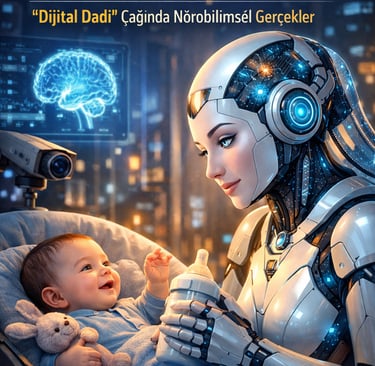
Our children's rooms are no longer just filled with plush toys, but with "smart" devices that are connected to the internet, recognize your voice, and answer your child's questions within seconds. AI-powered toys, emerging through collaborations between giant companies like Mattel and OpenAI, come to us with the promise of lightening the burden of parenting; however, the cost of this technological convenience may harbor hidden risks in the way a child understands the world and forms bonds. The warnings of UNESCO expert Dr. Kathy Hirsh-Pasek remind us that this process is actually much more than just an emotional exchange; it is the direct construction of the brain's physical structure.
Can Artificial Intelligence Replace a Real Bond?
Talking Barbies and analytical smart toys might seem like wonderful playmates on paper. However, human interaction is not just about words. For a baby, development is formed by the reassuring spark in their mother's eyes, the soft tone in their father's voice, and the warmth of their skin. No matter how flawless a storyteller AI becomes, it can never replicate this multi-dimensional human bond.
The human brain is a social miracle by nature and works like a "mirror," especially during the first 1,000 days of life. During this process, a phenomenon we call "attunement" occurs; the brains of the parent and the child almost become synchronized. When a mother smiles at her baby and the baby responds, happiness hormones are released simultaneously in both brains. An AI may answer a question correctly; however, it cannot provide the emotional depth and mental support a parent offers while giving that answer. According to experts, this type of "fake" attention can weaken a child's future ability to form bonds and solve social problems in the real world.
"Acquired Attention Deficit": The Invisible Trap of Screens
Screens and digital content are powerful agents that physically change the child's brain. "Groomed ADD" (Acquired Attention Deficit), emphasized by Dr. Hirsh-Pasek, explains how hyper-fast animations on screens and instant reward mechanisms turn the child's brain into a speed addict. For a child accustomed to this artificial speed, the natural flow of real life begins to feel "boring" over time. A teacher's calm lesson delivery does not satisfy this child.
The fundamental reason for this is that children have evolved to learn the world by touching 3D objects. The fact that a large portion of children under the age of 2 own their own tablets disrupts this developmental process; because this age group's capacity to learn from a screen is almost non-existent. The millisecond speeds of the digital world do not allow the brain to process information and transfer it to permanent memory. As a result, information flows away as if passing through a sieve, and deep learning does not occur.
Techno-Interference: The Invisible Distance Between Us
The danger is not only in the screen in the child's hand, but it is also hidden in our pockets. The term "Technoference" (Tekno-Müdahale) represents that silent disappointment the child experiences every time the parent's attention is interrupted by a phone. Checking a notification while your child is telling you something codes the message "This phone is more valuable than you" to them.
Research shows that children of parents whose attention is constantly distracted by a phone experience more temper tantrums and exhibit negative behaviors such as throwing toys to get attention. Language learning is a mutual interaction; when the parent becomes engrossed in the phone, this process stops and the developmental bridges in the child's mind remain incomplete.
Educational Apps: Reality or Marketing?
Thousands of "Educational" labels in app stores usually consist of a major misconception. Research reveals that only 2 out of the top 100 most popular educational apps meet real learning criteria. A truly educational app should possess these features:
Must Activate the Mind: The child should not be a passive viewer, but the decision-making party.
Must Provide Focus: It should not contain distracting advertisements and complex stimuli.
Must Be Meaningful: It should establish a direct connection with the child's real life.
Must Encourage Social Interaction: It should support communication with others.
Must Evoke Curiosity: It should direct the child toward discovery and trial-and-error.
Frequently Asked Questions (FAQ)
1. Should I keep my child completely away from technology?
No, banning technology entirely is not realistic. The important thing is to establish a balance. UNESCO experts recommend that screen time for children under age 3 be very limited (less than 1 hour per day) and must always occur in the company of an adult (co-viewing).
2. Can artificial intelligence help with language learning?
Yes, but only as a "tool". Language is learned within a social context. AI characters can increase vocabulary, but real human interaction is essential to teach how and why those words are used in social life.
3. How can I distinguish an "educational" app?
If the app has a structure consisting of constantly flashing lights, applause sounds, and forces your child to merely press a button, it is likely not educational. Prefer content that requires your child to think, strategize, and talk to you about the app.
4. Why does my child become more aggressive after screen time?
This is a result of "Groomed ADD" and excessive dopamine loading. Transitioning from the high speed of the digital world to the slowness of the real world can create intense frustration and regulation issues for a developing brain.
5. Are AI toys safe?
Most AI toys currently on the market are "early-stage" products. Since the long-term effects of these devices on child development have not yet been proven, UNESCO and scientific circles invite parents to be cautious and not substitute these devices for a "nanny".
Conclusion and Solution:
The 10-Minute Connection Prescription
Escaping the digital world completely may not be possible, but taking control is in our hands. The solution offered by Dr. Hirsh-Pasek is very simple yet revolutionary: Just 10 minutes a day!
Leave the phone in a completely different room, get down to your child's level, and just listen to them with uninterrupted eye contact. Even the world's most advanced artificial intelligence cannot build the brain cells created by that 10-minute real bond. Positioning artificial intelligence as an "assistant" rather than a "wall," and never letting go of parental guidance, is the key to raising the healthy brains of the future.