FILL OUT THE CONTACT FORM FOR A FREE 15-MINUTE CONSULTATION



The Experience Paradox in Education: How AI is Ending the Era of the 'Bad Teacher'
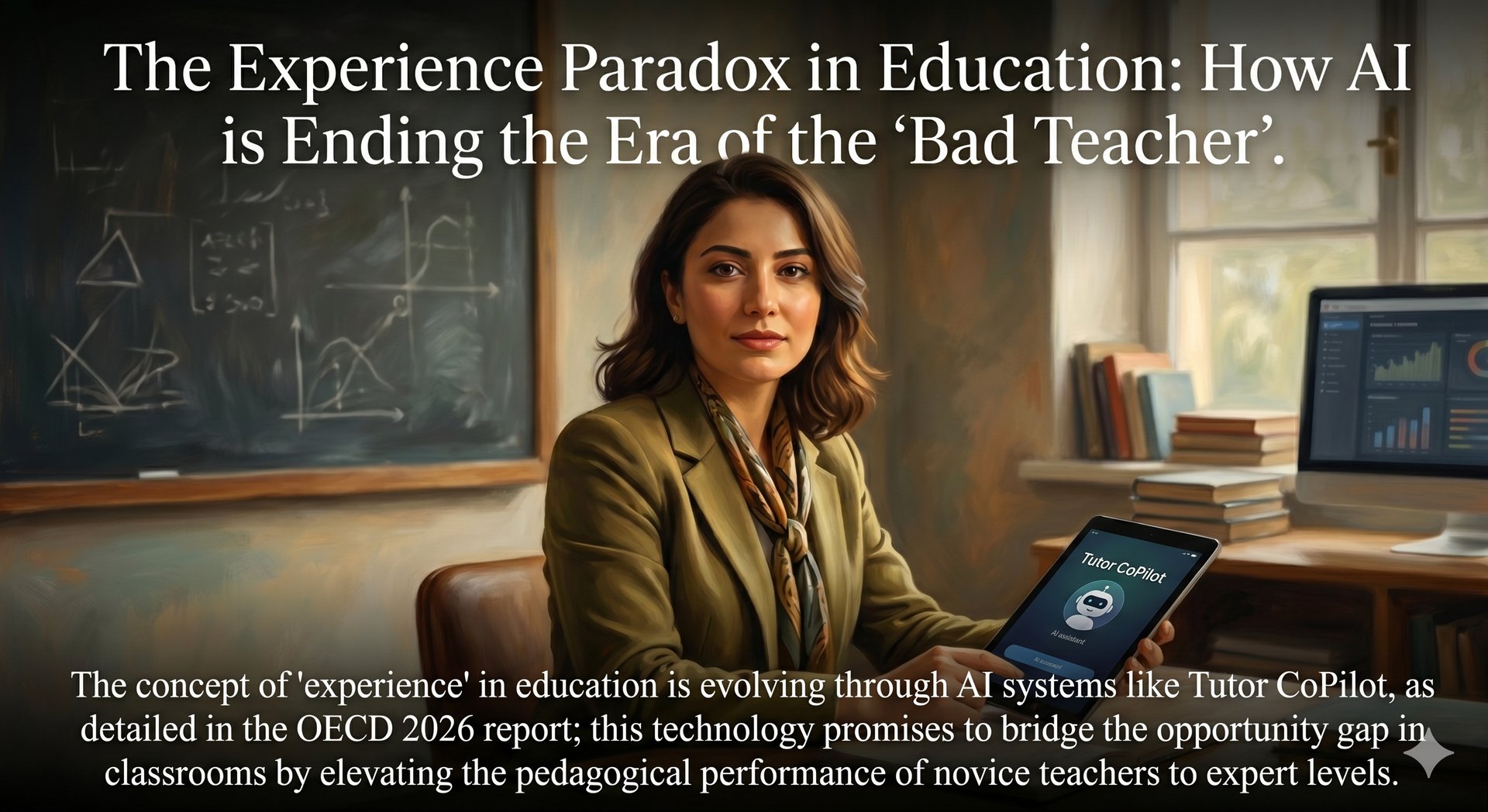
The concept of 'experience' in education is evolving through AI systems like Tutor CoPilot, as detailed in the OECD 2026 report; this technology promises to bridge the opportunity gap in classrooms by elevating the pedagogical performance of novice teachers to expert levels.
Özge Zeytin Bildirici
2/18/20264 min read
The Experience Paradox in Education: How AI is Ending the Era of the "Bad Teacher"
Think back to your school years. That first bell echoing through the hallways was actually the start of a silent lottery that would determine the rest of your life. Which classroom would you end up in? Would it be the one led by the "Legendary Teacher"—the one who transformed a complex differential equation or a historical event into a captivating tale, turning the lesson into a theatrical performance? Or would it be the classroom of the "Bad Teacher"—the one who muttered with their back to the board, ignored the spark of curiosity in your eyes, and prayed for the end of the period as fervently as you did?
For decades, the greatest structural injustice in the education system has been the chasm between these two profiles.
The Lucky Ones: Your potential is polished like a gemstone.
The Unlucky Ones: Your talents melt away within those four walls, crushed by the cold gears of a standardized curriculum.
In the educational community, this gap was always explained by a single word: Experience. They said, "They’ll mature over time." They indexed merit to seniority, claiming, "That teacher is a 20-year veteran, while the other is just a novice."
However, the OECD 2026 Report has placed data on the table that completely shatters this "cult of experience." We have officially entered the era of the "Cyborg Teacher"—a world where a trembling intern who started just yesterday can be transformed into a 20-year expert in a matter of seconds.
Invisible Genius: Tutor CoPilot Technology
The technology detailed in the OECD report and dubbed by educational scientists as the "Invisible Prompter of the Classroom" is called Tutor CoPilot. This system operates on an architecture very different from the static chatbots we use today. At its core lies the method of "Real-Time Pedagogical Scaffolding."
The Working Mechanism of the System
Imagine the system like this: You are in class, and the teacher is lecturing. But they are not alone. In their micro-earpiece or on the transparent screen in front of them is an AI that listens to them second by second and keeps a pulse on the classroom. This intelligence doesn't just hear words; it analyzes the student's hesitation time, the difficulty level of the question asked, and the teacher's current tone of voice. Then, it scans the world's most successful pedagogical strategies for that specific moment.
Application Example: Suppose a student, Ahmet, is stuck on the interior angles of triangles in math. An inexperienced teacher might panic and give the answer directly ("Ahmet, the answer is 180 degrees") or brush it off by saying "Look at the book again." But what does a master teacher do? They provide a hint that gets to the root of the problem.
This is exactly when Tutor CoPilot whispers to the teacher: "Don't give the answer. Remind Ahmet of the sum of the interior angles of a triangle with a concrete example. Give him an example using a pizza slice."
The teacher takes this "prompt" and explains the subject with a brilliant example. Ahmet's eyes light up. He thinks about how smart and talented the teacher in front of him is. Yet, that strategy did not come from the teacher’s mind, but from a processor in the cloud (an LLM-based pedagogical model). Here, the teacher merely took on the role of a talented "mediator."
Is Mastery Now Just a Software Update?
The most shocking and polarizing finding of the report for the education world is this: In controlled experiments, the success rates in classrooms of novice teachers using Tutor CoPilot reached the levels of 20-year expert teachers who did not use the system.
When we analyze this finding in depth, we encounter the "Democratization of Experience." That "intuition" and the ability to "capture the right moment," which a teacher acquires over 20 years through tens of thousands of hours of classroom experience, can now be replicated in milliseconds via software support. Artificial intelligence is zeroing out the "experience gap."
Why Aren't Experts Improving Further?
Another interesting detail in the report is the system's impact on senior teachers. When teachers who are already experts—those in the "legendary" pedagogical status—use this system, a massive leap in their performance is not observed. Why? Because the AI is already suggesting exactly what they have been doing automatically for years. In other words:
AI does not make the master more of a master;
But it transforms the apprentice into a master instantly.
This situation eliminates the risk of "mediocrity" in education while making the bar of "excellence" the new standard.
Data-Driven Evidence and References
This transformation is not merely a theoretical prediction. What is known in educational literature as Bloom's "2 Sigma Problem" (the fact that one-on-one tutoring is two standard deviations more successful than group instruction) is being addressed in classroom settings through intelligent systems like Tutor CoPilot.
Pedagogical Suitability: Similar research conducted by Stanford University (2024-2025 data) shows that teachers receiving AI-supported feedback saw a 40% increase in their use of Socratic Questioning—prompting students to think rather than simply correcting their mistakes.
Equality of Opportunity: The OECD report states that this technology offers a definitive solution to the problems of "teacher shortages" and "loss of quality," particularly in disadvantaged regions. A rural school that lacks access to the highest-tier educators can now possess the world's best pedagogical guidance thanks to Tutor CoPilot.
Conclusion: We are on the Brink of a New Educational Revolution
In education, "experience" is no longer a holy grail that takes 20 years to attain; it is transforming into a downloadable, updatable, and shareable software asset. The OECD 2026 report tells us this: in the schools of the future, there will be no "bad teachers." There will only be "teachers who use technology effectively" and "guides who inspire their students."
Frequently Asked Questions (FAQ)
1. Will Tutor CoPilot replace teachers? Absolutely not. The technology is an assistant that supports the teacher's pedagogical decisions. Classroom management, emotional intelligence, and the bond formed with the student remain entirely under human control.
2. Will this technology make students lazy? On the contrary, the main goal of the system is not to provide the answer, but to find the most accurate path to lead the student to it. This encourages the student to engage in deeper critical thinking.
3. Are experienced teachers opposing this system? While there are concerns regarding "professional autonomy" in some circles, many experts state that this system reduces administrative and preparation workloads, thereby leaving more time for creativity.
4. Is this system only applicable to quantitative subjects like mathematics? No. The report emphasizes that the system achieves similar success rates in verbal subjects, language learning, and even in artistic criticism processes.