FILL OUT THE CONTACT FORM FOR A FREE 15-MINUTE CONSULTATION



The Mirage of Pseudo-Mastery: Is AI Really Teaching?
The Turkey experiment in the OECD 2026 report has shocked everyone: students who use artificial intelligence perform 17% worse when the tool is taken away. Discover the mirage of pseudo-mastery.
Özge Zeytin Bildirici
2/3/20266 min read
The Mirage of False Mastery: Are We Truly Learning or Just Performing?
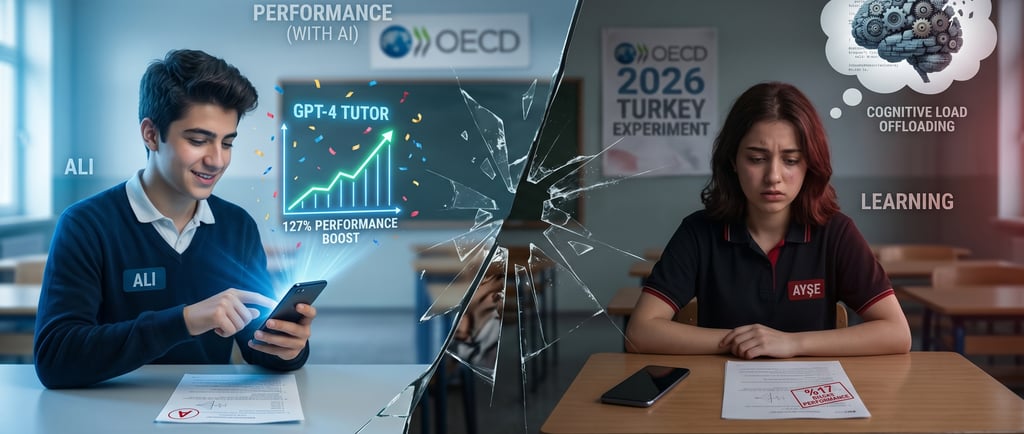
📌 Summary in One Sentence: According to OECD 2026 data, while artificial intelligence increases performance by 127%, delegating mental processes to the tool (Cognitive Load Offloading) regresses actual learning by 17%, creating a "Mirage of False Mastery."
Imagine you have a magic button at your fingertips. When you press this button, it solves the most complex math problem before you, writes the most challenging essay, or completes a coding project that would take weeks in mere seconds. The result is perfect. Your grade is an "A." At work, your boss is impressed with you.
You feel like a "master," don't you? After all, you delivered the work.
But there is a problem: When that button is taken away from you, your ability to do that work is in a worse state than before. You didn't just stay where you were; you regressed. This is the greatest paradox of the education world, hit home by the OECD's 2026 report: "The Mirage of False Mastery."
With the artificial intelligence revolution, the uncomfortable question we must ask ourselves is: Are we truly learning, or are we just performing?
The Cold Shower Effect: The 17% Warning from Turkey
In the Editorial section at the beginning of the OECD's "Digital Education Outlook 2026" report, a field experiment is mentioned that should make the hair on the necks of all educators and students stand up. This experiment was conducted in Turkey, and its results are like a slap in the face to technological optimism.
The design of the experiment is simple: Students are given a task. One group of students is granted access to GPT-4, one of today's most powerful AI models. The other group performs the task on their own.
The results are initially magnificent:
The performance of students using the standard GPT-4 interface increases by 48%.
The performance of those using the "Tutor" mode, specifically designed to support learning, soars by an incredible 127%.
Everything is great so far. You might say, "AI is making us superhuman!" However, the second stage of the experiment—the "Cold Shower"—begins here.
The researchers take the AI tools away from the students and leave them alone with a similar problem. What would you expect? That the students who practiced with AI and received support from the "Tutor" mode would have learned something, right?
You were wrong.
When the tools were taken away, these students who performed wonders with AI support showed 17% worse performance than the control group that never used AI.
Not better, not equal—17% worse.
This data proves something very important: The quality of the output is not proof of mental competence. Delivering a perfect assignment with AI does not mean you have learned that subject. In fact, on the contrary, you may have sabotaged your chance of learning that topic.
Cognitive Load Offloading: Why Is Our Brain Becoming Lazy?
So, how is it that practicing with a tool can make us less successful at that task? The report defines this situation as "Cognitive Offloading" or, in harsher terms, "Metacognitive Laziness."
Learning is, at its core, a process of "struggle." When our brain encounters a problem, it labors, tries to establish neural connections, makes mistakes, and corrects them. Learning happens exactly at that moment of "struggle." Psychologists call this "Desirable Difficulty."
When you use AI—especially when you use it in "give me the answer" mode—you take this difficulty away from your brain and hand it over to the machine. Your brain enters energy-saving mode, saying, "I don't need to solve this problem; the solution is already here."
This is exactly what happened in the experiment in Turkey. While using GPT-4, the students did not bother solving the logic of the problem. They only managed the AI. The tool did not "teach them how to fish"; it just "gave them the fish." Even in "Tutor" mode, students relied so much on the AI's guidance that they deactivated their own critical thinking skills.
We could also call this "GPS Syndrome." We haven't been memorizing addresses since navigation devices entered our lives. Because we delegated the job of finding the way (the cognitive load) to the satellite. When the navigation's battery dies, we get lost even in our own neighborhood. The students in the Turkey experiment also got lost in the streets of their own minds when left without AI.
Being a "Passenger" Instead of a "Pilot"
Another danger highlighted in the report is the impact of AI on teachers. In a study conducted in the UK, it was observed that the lesson planning times of teachers using AI decreased by 31%. A wonderful increase in productivity. However, the report warns: If teachers also delegate all processes to AI, their own pedagogical abilities may atrophy.
The use of AI in education is divided into three categories in the section of the report featuring Mutlu Cukurova:
Replacement: The AI doing the work entirely.
Complementarity: AI providing support under human control.
Augmentation: Human and AI doing something together that they could not do alone.
The problem is that a large portion of current use is focused on "Replacement." Students think they are using a "Co-pilot," but they are actually turning on "Autopilot" and leaning back. The plane flies, the view is beautiful, and the destination is reached—but the person in that seat is no longer a pilot, just a passenger.
In a moment of crisis (during an exam, when the internet is cut, or when faced with a "new" problem that AI cannot solve), they realize painfully that they lack the competence to land the plane. That 17% drop is the moment the plane crashes.
What Will Remain When the Mirage Fades?
This report and the data within it push us to radically question our understanding of education. For centuries, we built education on "finding the right answer." Exams rewarded the right answer; the business world demanded the right result.
But now, the "right answer" is free. Everyone has a machine in their pocket that produces the right answer in seconds. If the goal of education is only to "produce results," we no longer need humans.
To escape the "Mirage of False Mastery," we must shift the focus of education from "result" to "process." There are 3 things we can do for this:
Learning to Ask Questions: If AI provides answers, the human must ask questions. But I’m not talking about writing a simple "prompt." I’m talking about a mindset that can get to the root of the problem, question the machine, and ask, "Why might this answer be wrong?" As stated in the report, AI "hallucinates" frequently and tells convincing lies. Only those who truly master the subject can catch these lies.
Embracing Struggle: Educators must design processes where students can solve problems by collaborating with AI but by breaking a mental sweat.
Transparent Ignorance: Being able to say "I don't know" is more valuable than blindly trusting AI. The report states that even "Tutor" mode can undermine learning if not designed correctly. This is not a problem of technology, but of pedagogy.
Conclusion: AI as a Mirror
The OECD 2026 report is not a manifesto against technology. On the contrary, it provides much data praising AI's potential (such as personalized learning and saving time for teachers).
However, that experiment in Turkey points to the elephant in the room. AI is a mirror for us. When we look in that mirror, we see ourselves as smarter, more talented, and more productive than we are. But this is an optical illusion.
If, when we put that mirror down, we are left alone with the nakedness and inadequacy of our own minds, it means we are not progressing.
The next time you have ChatGPT write a paragraph or let AI "handle" a tough job, remember that 17% statistic. Ask yourself this question: "When this job is finished, did I develop, or did the job just finish?"
Because in the future, it won't just be the "job finishers" who win, but the "survivors" who can stay standing even when the machine is unplugged.
Frequently Asked Questions (FAQ)
What is the Mirage of False Mastery? It is the situation where an individual thinks they have truly learned a subject while producing flawless results with AI support, but fails when the tool is taken away.
Why can AI negatively affect learning? Due to "Cognitive Load Offloading," the brain stops struggling; because the mental effort required for deep learning is not spent, permanent knowledge is not formed.
What did the OECD 2026 Turkey experiment prove? It proved that students working with AI were very successful in the exam, but in a second test conducted without AI, they performed 17% worse than even the group that received no support at all.k almayan gruptan bile %17 daha kötü performans sergilediğini kanıtladı.