FILL OUT THE CONTACT FORM FOR A FREE 15-MINUTE CONSULTATION



The Silent Revolution in European Classrooms: How Are Teachers Using AI?
How are teachers in Europe utilizing artificial intelligence (AI) tools? A comprehensive analysis of why Eastern European countries are outpacing the West according to OECD TALIS 2024 data, the role of AI in lesson planning and assessment, and the curiosity and anxieties regarding the professional future of teachers.
Özge Zeytin Bildirici
12/11/20255 min read
The AI Revolution in European Education and the Human Factor
Artificial Intelligence (AI) is no longer just a neon-lit prop from a sci-fi flick or a secret whispered behind the closed doors of Silicon Valley. It’s woven into the fabric of our existence—from the phone we grab at sunrise to the algorithms suggesting our evening movies. It’s so close, in fact, that we often stop noticing it. For instance, with a pocket-sized mentor like Zey AI, spending just 15 minutes a day to master English isn't a luxury anymore; it’s our new normal.
However, when this digital tide hits the shores of the classroom, things get beautifully complicated. On one side, we have students buzzing with excitement, using ChatGPT to draft assignments in seconds. On the other, we see visionary educators turning this tech into an ally to personalize learning. Across the European continent, the picture isn't a monolith—it’s a vibrant, sometimes clashing mosaic. The OECD’s TALIS 2024 report decodes this for us: AI in Europe isn't spreading at a uniform pace; it’s a cultural reflex.
Three Different Europe
The Digital Pioneers, The Balance Seekers and The Cautious Observers
We often assume the heart of technology beats loudest in Berlin, Paris, or London. Yet, when it comes to AI in education, the data forces us to pause and rethink. While 52% of teachers in Albania actively use AI in their classrooms, that figure drops to 25% in Italy and 27% in Finland—a country whose education system we’ve admired for decades.
The OECD TALIS 2024 data categorizes the European education map into three main archetypes. This isn't just about numbers; it’s a strategic indicator of how nations are preparing their future workforce:
🚀 1. The Digital Pioneers: "The Fearless Experimenters" (45% and Above)
These nations have bypassed red tape to bring tech directly into the classroom. They are the leaders of "early adoption."
Albania (52%): The surprising leader of Europe. By substituting limited physical resources with digital assistants, they’ve created a massive experimental playground.
Malta (47%): Leveraging the agility of a small island state, Malta has become one of the fastest to adapt its curriculum to AI integration.
Czechia (46%): Here, teacher autonomy in digital content creation is at its peak. AI isn't a mandate; it’s a teacher’s initiative.
Poland (45%): Through systematic state support for teacher training, they’ve turned AI into a core methodology.
⚖️ 2. The Balance Seekers (30% - 44%)
Countries with high tech access that are trying to weigh digital speed against pedagogical values.
Croatia (44%): Showing a rapid rise by centering their digital reform processes around AI.
Norway (40%): The most tech-friendly nation of the North. For them, AI is a natural complement to human-centric education.
Slovenia (38%): Achieving one of the most consistent harmonies between technical infrastructure and classroom practice.
Spain (30%): While usage peaks in tech hubs like Madrid and Barcelona, they are working hard to bridge the digital divide with rural regions.
🐢 3. The Cautious Observers: "Rule First, Apply Later" (21% - 29%)
These nations move slower due to ethical concerns, data privacy, and deeply rooted educational traditions.
Finland (27%): Despite having one of the world's best systems, they lag behind. The reason? A "pedagogical conservatism" born from the fear of weakening the human bond.
Italy (25%): Deep-seated bureaucratic procedures and heavy approval cycles for digitalization are slowing the momentum.
Turkey (24%): While individual teacher interest is high, the central system’s cautious approach and the wait for comprehensive ethical guidelines limit widespread use.
Hungary (21%): Still primarily focused on traditional digital platforms rather than generative AI.
This isn't an infrastructure or internet speed issue; it’s a matter of mindset and the "courage to experiment." Eastern Europe’s pragmatic approach has overtaken bureaucratic anxiety. While the West says,
"Let’s draw ethical boundaries and debate data protection for a decade before we start",
the East says, "Let’s use the tool, see the benefit, and fix the bugs on the way."
How Are Teachers Actually Using AI?
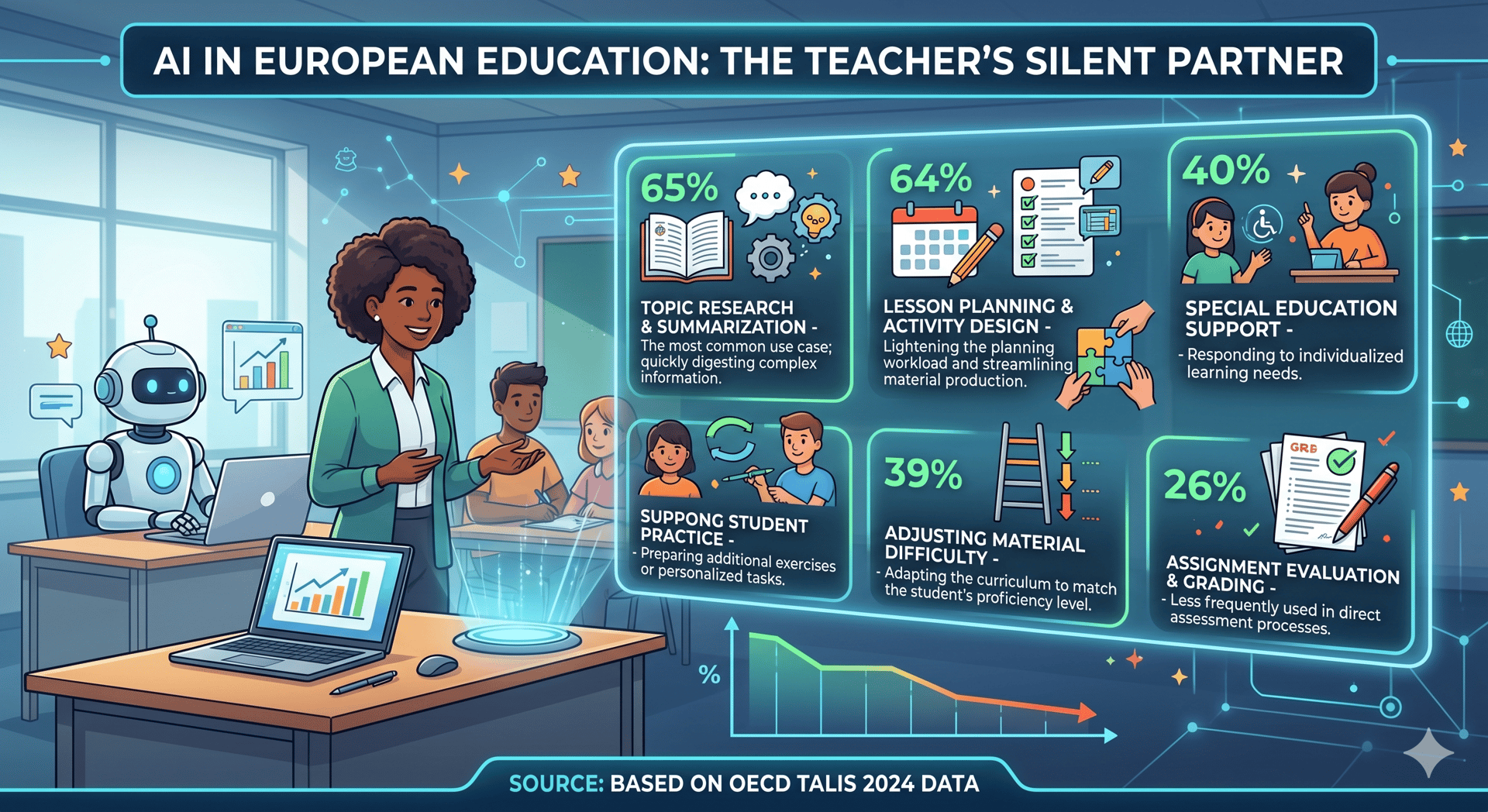
Currently, we don't see robot teachers roaming the hallways. Instead, AI acts as a "silent, hyper-fast" assistant. TALIS data reveals that teachers use this tech more to lighten their own workload than for direct student interaction.
Application Area Usage Rate Real-Life Impact
Research & Summarization 65% Turns weeks of source scanning into mere minutes.
Lesson Plan Creation 64% Enriches the curriculum with more creative activities.
Personalized Support 40% Generates custom material tailored to each student’s pace.
Grading & Assessment 26% The least used area; grading still demands a "human touch."
The takeaway is clear: AI is not yet on the teacher's podium; it’s sitting on the teacher's desk. As seen in the France 2025 initiative, governments are now starting to "formalize" this assistant. France’s national program aims to teach AI not just as a tool, but as an ethical and pedagogical culture—the sweet spot between going fast and going right.
The Classroom of the Future: Human and AI Hand in Hand
The classroom of the future will be a place where human empathy meets the data-processing power of the machine. AI can analyze data or find errors in a test paper in seconds; however, no algorithm can motivate a student sitting with their head bowed after a failure, nor can it recognize the spark in their eyes when they discover a hidden talent.
The heart of education remains human. AI is the technology that helps this heart beat more rhythmically, but the soul is still in the hands of the teacher. Europe’s digital journey is less about where technology will take us and more about where we will steer the technology.
Conclusion: Staying Human Under the Spotlight
All this data and regional strategy point to one truth: AI might be the new classroom assistant, but it will never be the leader. This rising technological tide across Europe offers a unique opportunity—not to replace the teacher, but to return them to their true expertise: the art of "nurturing humans."
A teacher who offloads paperwork to an algorithm gains the space to focus on a student’s dreams. At the end of the day, no matter how valuable a digital assistant’s flawless lesson plan is, the one who breathes life into it, draws the ethical framework, and taps a student on the shoulder to say "You can do this" will always be the teacher. The future of education may be digital, but its success will always be human.
Frequently Asked Questions (FAQ)
1. Will AI make teachers redundant? Absolutely not. On the contrary, AI handles routine administrative tasks like grading and lesson planning, allowing teachers to spend more high-quality, one-on-one time with their students. Since teaching is built on human connection, AI remains a supportive tool, not a replacement.
2. Which country has the highest AI usage according to TALIS 2024? The report identifies Albania as the leader with a 52% usage rate among teachers, followed closely by Malta, Czechia, and Poland.
3. What is the biggest risk of using AI in the classroom? The primary risks include data privacy breaches, algorithmic bias, and the potential weakening of students' critical thinking skills. This is why many European nations are prioritizing the development of ethical guidelines.
4. Does AI actually improve student achievement? Yes, primarily through "personalized learning." AI allows students to progress at their own pace. Research shows that when used with proper teacher guidance, AI tools significantly boost success rates, especially for students with learning difficulties.
5. Where should a teacher begin with AI? The best starting point is experimenting with text-based tools (like ChatGPT) for lesson planning or specialized assistants (like Zey AI) for language learning. Incorporating tech in small doses into daily routines makes the transition seamless.