FILL OUT THE CONTACT FORM FOR A FREE 15-MINUTE CONSULTATION



What Does the Younger Generation Expect from an AI-Powered Future of Education?
Are young people afraid of AI? In light of Oxford University Press’s June 2026 report "Navigating AI in Education," discover why 69% of students view an AI-driven educational future with massive excitement and optimism, alongside their expectations for personalized learning and the concept of a creative "sparring partner."
Özge Zeytin Bildirici
6/29/20267 min read

Editor’s Note / This is a Blog Series
Dear Readers,
In the world of educational technology and digital pedagogy, I deeply value discussing the role of artificial intelligence not just as a technical tool, but through a vision that places the human, the teacher, and the student at the very center. Right at this juncture, Oxford University Press (OUP) published a highly striking and up-to-date research report in June 2026: "Navigating AI in Education."
This comprehensive report sheds light on the actual place of AI in classrooms, the ethical confusion experienced by young students, the lack of guidance in schools, and, most importantly, the irreplaceable human and emotional bond that teachers provide.
Rather than cramming all the valuable data, statistics, and pedagogical insights from the report into a single post, I have prepared a special 6-part blog series to examine each dimension in depth. Welcome to the fourth part of this series, where we treat AI not as a threat or a mere disruptor, but as a partner reshaping the architecture of education!
Part 1: Is Using AI for Homework Cheating? The "Gray Area" Dilemma of Youth
Part 2: AI Enters the Classroom, But Teachers Are Irreplaceable: Why Do Youth Want "Humans"?
Part 3: Has AI Guidance Failed in Schools? The Great Call from Students
Part 4: Excitement, Not Fear: What Does the Younger Generation Expect from an AI-Powered Future of Education? (You are here)
Part 5: The Great Misconception About AI: Young People Are Not as "Shortcut-Oriented" as Thought
Part 6: The Oxford Guide for Teachers: How to Correctly Manage AI Potential in the Classroom
Enjoy the read! Please remember to share your comments, your own classroom experiences, and your learning journeys throughout this series!
"In the future business world, robots will replace humans, starting a wave of mass unemployment." For the last few years, this has been one of the most common sentences we hear in AI panels, mainstream news broadcasts, and dystopian Hollywood movies. The adult world observes AI with immense existential anxiety, a fear of losing their professions, and deep skepticism. But what is the situation in classrooms? How do young people—born right into the heart of the digital world and the true owners of the future—feel about this situation?
Oxford University Press (OUP), casting a global projection on the education and technology ecosystem, offers wonderful, paradigm-shifting insight on this matter with its June 2026 report, "Navigating AI in Education." The report proves that, unlike adults, the new generation looks at AI not through a window of fear, but through a lens of immense excitement and optimism.
Let's explore the reasons behind this high energy of the digital generation, exactly what they expect from an AI-supported future of education, and how these expectations will transform educational architecture together.
What Does the Data Say? Youth's AI Optimism
Institutional approaches that try to restrict the use of AI tools or view this technology solely as a source of threat remain far from understanding the mindset of young people. For the new generation, AI is not an external technology learned later in life that requires forced adaptation. For them, these tools are a natural, organic, and inseparable part of life—just like the internet or smartphones.
The critical statistic in the OUP report, which will refresh the vision of all of us as educators, states exactly this:
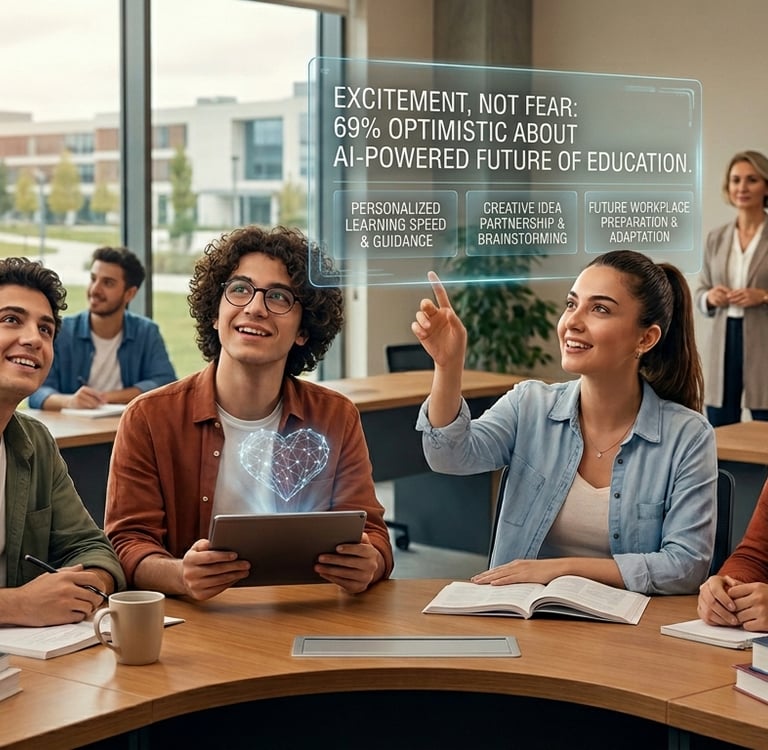
69% of the students participating in the research state that they feel immense excitement and optimism about the future of AI in education and their own learning processes.
This data exposes a very clear truth: Young people do not view AI as a "threat element" or an "escape route" that will drive them to laziness. They position this technology as a powerful lever for progress that will maximize their own potential and make learning experiences much more enjoyable and efficient. With great curiosity, they want to see how this technology can make the educational system fairer, more flexible, and more personal.
What Do Young People Expect from an AI-Powered Education?
There is a very healthy gap between the theoretical answers adults give to the question "How will AI affect education?" and the practical expectations of students on the ground. Young people imagine AI as a partner that solves tangible real-life problems.
According to the results of the report, the top 3 expectations of the young generation from an AI-supported educational future are:
1. Personalized Learning Speed
One of the biggest bottlenecks of the traditional educational model is expecting every student in a 30-person classroom to learn at the same speed, with the same method, and in the same timeframe. Yet, while the rest of the lesson becomes boring for a student who grasps a concept within minutes, another student who needs more time experiences the academic anxiety of lagging behind.
Young people expect AI to be a "personal learning assistant" at this exact point. AI is a partner that does not judge, is patient, analyzes the student's weak and strong points, and produces tailor-made practices for them. Students do not hesitate to ask AI the same question 10 times in a row because there is no pressure of authority across from them that would make them feel lazy or punish them with a low grade.
2. Creativity and Idea Partnership
The new generation does not want to use AI merely as an encyclopedia that dishes out ready-made answers to questions. They view AI as a creative "idea partner" with whom they can test their original ideas and brainstorm. Interacting with AI while writing an essay, developing a project, or making a new design provides them with different perspectives and feeds their creative processes.
3. Realistic Preparation for the Future Business World
Young people possess a highly rational awareness. They know very well that AI will be at the center of every sector in the business world they step into upon graduation. Therefore, they do not expect schools to ban AI; on the contrary, they want schools to teach them how to produce professional projects, analyze data, and stay competitive in the digital world using these tools. Their excitement is fueled by the desire to be thoroughly equipped for the future.
The Source of Fear is Not AI, But the System's Inertia
This 69% excitement felt by students harbors an indirect critique toward the educational system. Students are not afraid of AI; however, they worry that the educational system, schools, and curricula will remain stagnant and fail to keep pace with this speed.
As we saw in the previous section, schools failing in guidance and seeking refuge in the reflex to ban risks dampening this positive energy and excitement of youth. While young people enter the classroom with a grand digital vision and curiosity, they end up disappointed when faced with a traditional approach that treats AI purely as a "cheating tool."
What we truly need to do as educators and school managers is to support this high motivation and optimism of youth through institutional structures. Instead of suppressing their excitement with a culture of fear, we must direct this energy into the correct pedagogical channels.
Final Words: Youth's Optimism Will Build the Future of Education
The June 2026 report by Oxford University Press brings a fresh and hopeful breath to the AI discussions in the educational world. Despite all the dystopian fear scenarios manufactured by adults and the system, the younger generation continues to look to the future with great faith and excitement.
They do not view AI as a monster that will eliminate humans, but as a tremendous partner that will exponentially multiply human potential, creativity, and wisdom. The educational architecture of the future will not be built with stagnant rules terrified of technology; it will be constructed with young people who embrace technology with great excitement and want to manage it in a human-centered way.
Our duty is not to block their way or stand against this digital wave, but to guide them so they can thrive on that wave safely and with ethical values. Because the future will belong not to those who fear it, but to those who design it with immense excitement.
In the next part of our blog series, we will completely shatter the biggest societal prejudice regarding the young generation using AI. Are we facing a shortcut-oriented generation that wants to leave everything to a robot as assumed, or is the situation entirely different? See you in Part 5: "The Great Misconception About AI: Young People Are Not as 'Shortcut-Oriented' as Thought." Let's meet in the comments: Do you feel fear or excitement when you think about the AI-supported classrooms of the future?
Frequently Asked Questions (FAQ)
1. According to the Oxford University Press June 2026 report, what is the general attitude of young people toward AI?
In contrast to adults, the younger generation harbors great optimism toward AI. 69% of the surveyed students state that they have high excitement and positive expectations regarding the future of AI in education and its contribution to their own learning processes.
2. How do students expect AI to contribute to their individual learning processes?
Students expect AI to act as a personal "individual learning assistant." They demand the ability to progress at their own learning speed, ask questions they don't understand repeatedly in a pressure-free, sterile environment, and perform personalized practices targeting their weak spots.
3. How does the younger generation view AI as a creative tool?
Young people position AI not merely as a source of ready-made information, but as a creative "sparring partner" with whom they can test ideas, brainstorm, and gain diverse perspectives. Technology feeds rather than restricts their creative processes.
4. What is the biggest difference in approach between adults and youth regarding AI?
While adults and institutional structures generally approach AI from the perspective of existential anxiety, fear of job loss, and academic integrity violations (cheating), young people feel immense excitement, viewing this technology as a natural part of life, a lever to boost their potential, and a tool to prepare for the future business world.
5. How should educational systems respond to this AI excitement of young people?
Instead of suppressing this high motivation with bans and a culture of fear, educational systems should support it in alignment with digital pedagogy principles. Schools must create safe spaces for innovation and clear institutional policies so that students can utilize this energy ethically, honestly, and critically.