FILL OUT THE CONTACT FORM FOR A FREE 15-MINUTE CONSULTATION



Why Did Norway Ban AI in Primary Schools?
A massive turnaround in education! Explore Norway’s AI ban in primary schools, the decline in PISA scores, and the Zey AI graduated education model designed to raise the leaders of tomorrow.
Özge Zeytin Bildirici
6/20/20269 min read
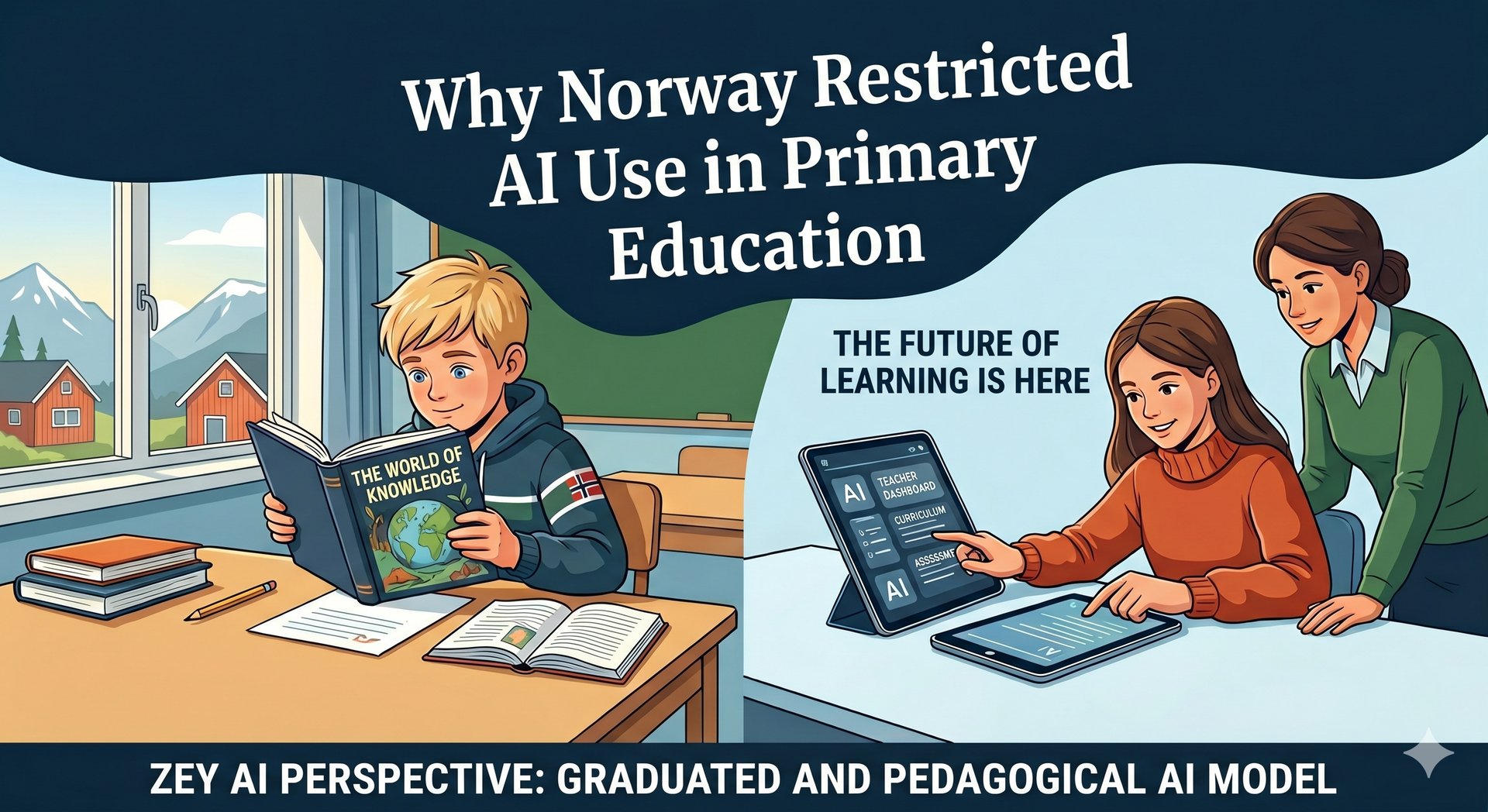
We are at the peak of the "smart" education era—a time when the winds of digitalization blow hardest, tablets replace blackboards, and screens take the place of notebooks. Or perhaps, we are at the very turning point where we begin to roll down from that peak.
On June 19, 2026, global news emerging from Oslo sent shockwaves through the world of educational technology. Norway, known for being at the forefront of embracing technology and innovation, announced that it is essentially banning the use of generative artificial intelligence (Generative AI) in primary schools.
Announced by Norwegian Prime Minister Jonas Gahr Støre and Education Minister Kari Nessa Nordtun, this radical decision left not just Scandinavia, but the entire world facing a critical question: Is AI turning children into geniuses, or is it making fundamental human skills lazy?
In this article, we lay out the backstage of this historic decision made by Norway, the pedagogical risks of using AI in Education, and the trend of shifting from digital obesity back to "analog depth."
What Does Norway’s AI Decision Mean? (New Rules Grade by Grade)
The Norwegian government has not declared an absolute war on artificial intelligence. Instead, it is building a highly strategic and gradual barrier tailored to the cognitive development of each age group. The national recommendations, effective from the start of the 2026-2027 academic year, rest on three main pillars:
1. Primary School Level (Grades 1 - 7): The Absolute Protection Corridor
Children between the ages of 6 and 13 are completely blocked from accessing generative AI tools (such as ChatGPT, Midjourney, etc.) during school activities. The goal is to prevent children in this age group from getting "ready-made copies" from AI while doing homework, writing essays, or conducting research.
2. Lower Secondary School Level (Grades 8 - 10): The Controlled Laboratory Period
AI is not entirely banned for the 14-16 age group, but it is subject to a very strict teacher filter. Students will only be allowed to experience these tools in the classroom under direct guidance and through "cautious trials" once their teachers have attained sufficient expertise in AI literacy.
3. High School Level and Beyond: Professional Alignment
For students aged 17 and older, the approach is entirely different. These young individuals are encouraged to learn how to use AI ethically, critically, and appropriately to prepare for their future academic and professional lives. In other words, high school will be the place where AI is taught not as a "shortcut," but as a "lever."
Important Exception: Students who need AI-based supportive tools due to various special education needs or disadvantages in language learning will be allowed to continue using them within individualized education plans.
PISA and PIRLS Alarms: How Screens Melted Children's Skills
So, why did a country at the vanguard of digitalization pivot overnight? The answer lies hidden in painful statistics.
The biggest problem highlighted in Education Minister Kari Nessa Nordtun’s statements is the dramatic decline of Norwegian students in international achievement rankings like PISA and PIRLS. According to recent research:
1 in 4 Norwegian students falls below the minimum reading threshold set by the OECD for qualifying for further schooling and work.
Following the uncritical introduction of digital tablets into classrooms, a serious regression has been observed in children's ability to understand long texts, focus deeply, and think abstractly.
When AI tools are factored into this equation, the process becomes even more damaging for the child. A child who needs to write an essay or figure out the logic behind a math problem can reach a perfect result in seconds just by typing a prompt.
The pedagogical danger here is this: The child reaches the final product (the homework), but completely bypasses the cognitive processes (making mistakes, trial and error, searching for words, reasoning) they need to go through to produce that product. In other words, the one learning while doing the homework is not the child, but the AI's algorithm.
Pedagogical Risks of AI in Education: Why Must We Stop Now?
For an educational technology (EdTech) tool to be beneficial, it must support the learner's cognitive capacity, not replace it. We can summarize the harms of generative AI during primary school ages under three main headings:
1. Decrease in Self-Regulation and the Patience Threshold
AI creates instant gratification. A child asks a question and receives an answer within fractions of a second. Yet, real learning requires getting bored, struggling, getting lost in library or book pages, and exercising patience. Children accustomed to AI at an early age experience shortened attention spans and show a tendency to avoid difficult tasks.
2. The Erosion of Critical Thinking
AI models are prone to "hallucinating"—that is, presenting incorrect information in a very confident tone as if it were true. A primary school-aged child has not yet developed the digital literacy and critical lens required to detect logic errors or manipulations in an AI-generated text. The child faces the risk of accepting everything on the screen as absolute truth.
3. Weakening of Social and Emotional Bonds
Learning is not just the electrical activity of neurons; it is a social act. A child grows by making eye contact with their teacher, discussing with their deskmate, and feeling a healthy sense of accountability when making a mistake to try harder next time. Positioning AI as a "personal tutor" isolates the child behind a screen with an assistant, driving them toward social isolation.
From the Smartphone Ban to the AI Limit: Norway’s "Analog Renaissance"
In reality, this step by Norway is no surprise. The government had previously banned smartphone use during school hours. The results of that ban, which initially sparked debates about "restricting freedoms," were tremendous:
A visible drop was observed in cases of peer cyberbullying in schools.
Students' in-class focus rates and academic grades improved.
The rates of children physically playing games and socializing with each other during recesses increased.
Education Minister Nordtun offered a self-critique regarding the past uncritical digitalization craze, stating, "We must not make the same mistake as when digital devices were uncritically introduced among the youngest students." Along with this new decision, the Norwegian government commits to allocating a budget to increase the use of physical books, paper, and pencils in schools. This stands as the clearest proof that an "Analog Renaissance" has begun in education.
What Should the Education Model of the Future Look Like? (Zey AI Perspective)
As Zey AI, one of the prominent platforms when it comes to AI integration in education, we view this radical move by the Norwegian government as highly justified and a strategically vital turning point from a pedagogical standpoint. There is a principle we always champion: Artificial intelligence should not be a crutch that makes a student's mental muscles lazy; it must be a lever that elevates their intellectual capacity.
Norway's decision is not a regressive backlash directed at technology itself; rather, it is a visionary move saying "stop" to the damage that uncontrolled digitalization inflicts on a child's soul and mind. According to the Zey AI pedagogical approach, a child must first reach a certain chronological and cognitive maturity before interacting with AI. Having a primary school-aged child do their homework via ChatGPT is not a digital transformation; it is cognitive suicide. Because while that child reaches the final product in seconds, they completely bypass the most fundamental learning steps that make us human, such as making mistakes, vocabulary retrieval, structuring logic, and building patience.
According to the "Graduated AI Literacy" model developed and advocated by Zey AI, the educational roadmap of the future should be shaped according to the following age groups:
Education Method & Focus
The Role of Technology and Screens from a Zey AI Perspective
Ages 0 - 2 (Infancy)
Education Method & Focus: Motor skills, sensory exploration (touch, taste, smell), eye contact with parents, and mimicking facial expressions.
The Role of Technology and Screens from a Zey AI Perspective: Strictly Zero Screens Two-dimensional screens and AI are completely banned during this phase of rapid brain development. (The only exception: very brief video calls with family).
Ages 3 - 6 (Preschool)
Education Method & Focus: Language development, social games, gross and fine motor skills, exploring the analog world and nature.
The Role of Technology and Screens from a Zey AI Perspective: Zero Screens in an Ideal Scenario If screens are to be used, they must be limited to a maximum of 30-45 minutes daily, consisting of slow-paced, educational content, and always accompanied by a parent (interactive). No AI use.
Ages 7 - 13 (Primary School - Norway Model)
Education Method & Focus: Fundamental reading and writing, analytical thinking, physical books, concrete mathematics, and strengthening mental muscles.
The Role of Technology and Screens from a Zey AI Perspective: Viewer Role (Generative AI Banned) The student cannot use AI tools themselves. AI is only present at a minimal level under teacher control as a "demonstration tool" to help make abstract concepts concrete in the classroom.
Ages 14 - 16 (Lower Secondary)
Education Method & Focus: Critical thinking, research techniques, questioning skills, and digital literacy.
The Role of Technology and Screens from a Zey AI Perspective: Partner Cautious trials begin under teacher guidance. Students are taught how to give correct commands (prompts) to AI and how to verify the accuracy of AI-generated information.
Ages 17+ (High School & Beyond)
Education Method & Focus: Project production, career orientation, academic deepening, and managing creative processes.
The Role of Technology and Screens from a Zey AI Perspective: Full Integration AI serves as the student's intellectual productivity partner. It is used actively and within ethical boundaries during brainstorming, data analysis, and optimization processes.
The magic formula here is not to completely ban technology and disconnect from the world; it is to include AI in the process at the right time, in the right dose, and with the right pedagogical filter. This is precisely our vision at Zey AI: The successful individuals who will make a difference in the world of the future will not be those who had AI simulate their homework in primary school; they will be the leaders who fully developed their analog mental muscles in the physical world during primary school, and who can manage AI like a "mind architect" during high school and beyond. We will continue to say "human first, machine second" to raise generations that steer technology rather than consume it.
Conclusion: For Generations That Govern Technology, Not Consume It
This new regulation brought by Norway to the use of AI in education is not a reactionary reflex that excludes technology; on the contrary, it is a highly visionary step aimed at protecting the unique potential of the human mind.
The primary purpose of education is to equip an individual with the skill to process, question, and structure information, going far beyond merely accessing it. Allowing children who have not yet completed their cognitive development, literacy foundations, and analytical thinking fundamentals to hand over their learning processes to AI directly hinders the growth of these mental muscles. A generation that gets used to ready-made algorithmic outputs instead of producing their own ideas, finding the truth by making mistakes, and focusing with patience faces the risk of transforming into passive consumers directed by technology rather than leaders governing it.
As we always emphasize at Zey AI, the leaders of the future will not be those who run away from AI, but those who grasp its working logic and control it as a tool. With its "human first, machine second" philosophy, the Norwegian government has presented a very powerful model to the world to bring the place of technology in education into a pedagogical balance. Given the global wave of academic decline, it seems inevitable that other countries will soon listen to this pedagogical call.
Frequently Asked Questions (FAQ)
1. Is artificial intelligence completely banned in Norwegian schools?
No, AI is not completely banned; a pedagogical filter has been introduced based on the cognitive development of age groups. According to the new regulation, primary school students between grades 1 and 7 (ages 6-13) are essentially banned from using generative AI tools themselves for homework and lessons. While limited testing under teacher supervision is allowed in lower secondary schools, full integration is encouraged at the high school level to prepare students for the professional world.
2. Does banning AI at an early age cause children to fall behind in the future?
Pedagogical and neurological research shows quite the opposite. Children who fail to fully develop core mental muscles such as reading, writing, problem-solving, and focusing through "analog" methods (with physical books, paper, and pencils) at an early age cannot use AI efficiently in later years either. On the flip side, children with a solid foundation can govern AI not as a crutch, but as a powerful "mind architect" during their high school and university years.
3. According to the Zey AI model, what is the most ideal age for children to be introduced to screens and AI?
From the Zey AI pedagogical perspective, the first 6 years are the golden period when the analog infrastructure of the human mind is established. Screen time should be strictly zero between the ages of 0 and 2. Between ages 3 and 6, the "zero screen" ideal should be maintained; if used, slow-paced content not exceeding 30-45 minutes daily should be preferred, always accompanied by a parent. The most ideal period for the first individual and controlled introduction to AI (prompt literacy) is the lower secondary school period (ages 14-16), when critical thinking begins to mature.
4. What is the primary reason behind the Norwegian government stepping back from digitalization in education?
The biggest factor is the dramatic decline in PISA and PIRLS results following uncontrolled tablet and screen use. The fact that 1 in 4 students in Norway fell below the minimum threshold in reading skills prompted the government to take action. Research has proven that generative AI bypasses learning processes like making mistakes, questioning, and practicing patience, which in turn erodes children's deep attention span.
5. Will Turkey and other countries around the world implement Norway's AI decision?
Many European nations, including France, the Netherlands, and the UK, are already following the school smartphone ban model that Norway implemented earlier. Since digital obesity and the cognitive laziness caused by AI at an early age form a global issue, it is highly anticipated that this "Analog Era in Education" movement started by Norway will soon be taken onto the agenda of UNESCO, EU Education Commissions, and ministries of education in other countries, including Turkey, as a reform model.