FILL OUT THE CONTACT FORM FOR A FREE 15-MINUTE CONSULTATION


AI Enters the Classroom, But Teachers Are Irreplaceable: Why Do Youth Want "Humans"?
Will AI replace teachers, or is the human connection in education permanent? In light of Oxford University Press’s June 2026 report "Navigating AI in Education," we explore why 73% of young students insist on having human educators. Discover the power of emotional intelligence, empathy, and mentorship in building the hybrid classrooms of tomorrow.
Özge Zeytin Bildirici
6/18/20267 min read
Editor’s Note:
Dear Readers,
In the world of educational technology and digital pedagogy, I deeply value discussing the role of artificial intelligence not just as a technical tool. Instead, we must focus on a vision that places the human, the teacher, and the student at the very center. Right at this juncture, Oxford University Press (OUP) recently published a highly striking and up-to-date research report in June 2026: "Navigating AI in Education."
This comprehensive report sheds light on the actual place of AI in classrooms. It highlights the ethical confusion experienced by young students, the lack of guidance in schools, and, most importantly, the irreplaceable human and emotional bond that teachers provide.
Rather than cramming all the valuable data, statistics, and pedagogical insights from the report into a single post, I have prepared a special 6-part blog series to examine each dimension in depth. We will not look at AI as a threat or a mere disruptor. Instead, we will explore it as a partner reshaping the architecture of education.
Part 1: Is Using AI for Homework Cheating? The "Gray Area" Dilemma of Youth
Part 2: AI Enters the Classroom, But Teachers Are Irreplaceable: Why Do Youth Want "Humans"? (You are here)
Part 3: Has AI Guidance Failed in Schools? The Great Call from Students
Part 4: Excitement, Not Fear: What Does the Younger Generation Expect from an AI-Powered Future of Education?
Part 5: The Great Misconception About AI: Young People Are Not as "Shortcut-Oriented" as Thought
Part 6: The Oxford Guide for Teachers: How to Correctly Manage AI Potential in the Classroom
Enjoy the read! Please share your comments, your own classroom experiences, and your learning journeys throughout this series.
Do you remember the early predictions made by those who claimed AI technologies would radically change education? They said: "Soon, there will be no need for schools or classrooms. Every student will have an AI teacher on their screen, everyone will learn at their own pace, and algorithms will replace human teachers." While these claims remain incredibly popular in the tech world, the reality on the ground—inside real classrooms—has taken a completely different turn.
Oxford University Press (OUP), keeping its finger on the pulse of the educational world, published its latest research report in June 2026: "Navigating AI in Education." This report presents fresh data that flips those futuristic prophecies upside down and forces us to think deeply. It reveals why young people, who were born right into the center of the digital world, put AI aside and insist on a "human teacher" when it comes to learning.
Let’s examine this striking demand from the digital generation, the irreplaceable "human superpowers" of educators, and the future architecture of education together.
What Does the Data Say? Youth Want a Human-Centered Classroom
No matter how advanced the language models produced by tech companies become, the hearts and minds of students still belong in the classroom with their teachers. One of the most remarkable statistics from the OUP report highlights exactly this:
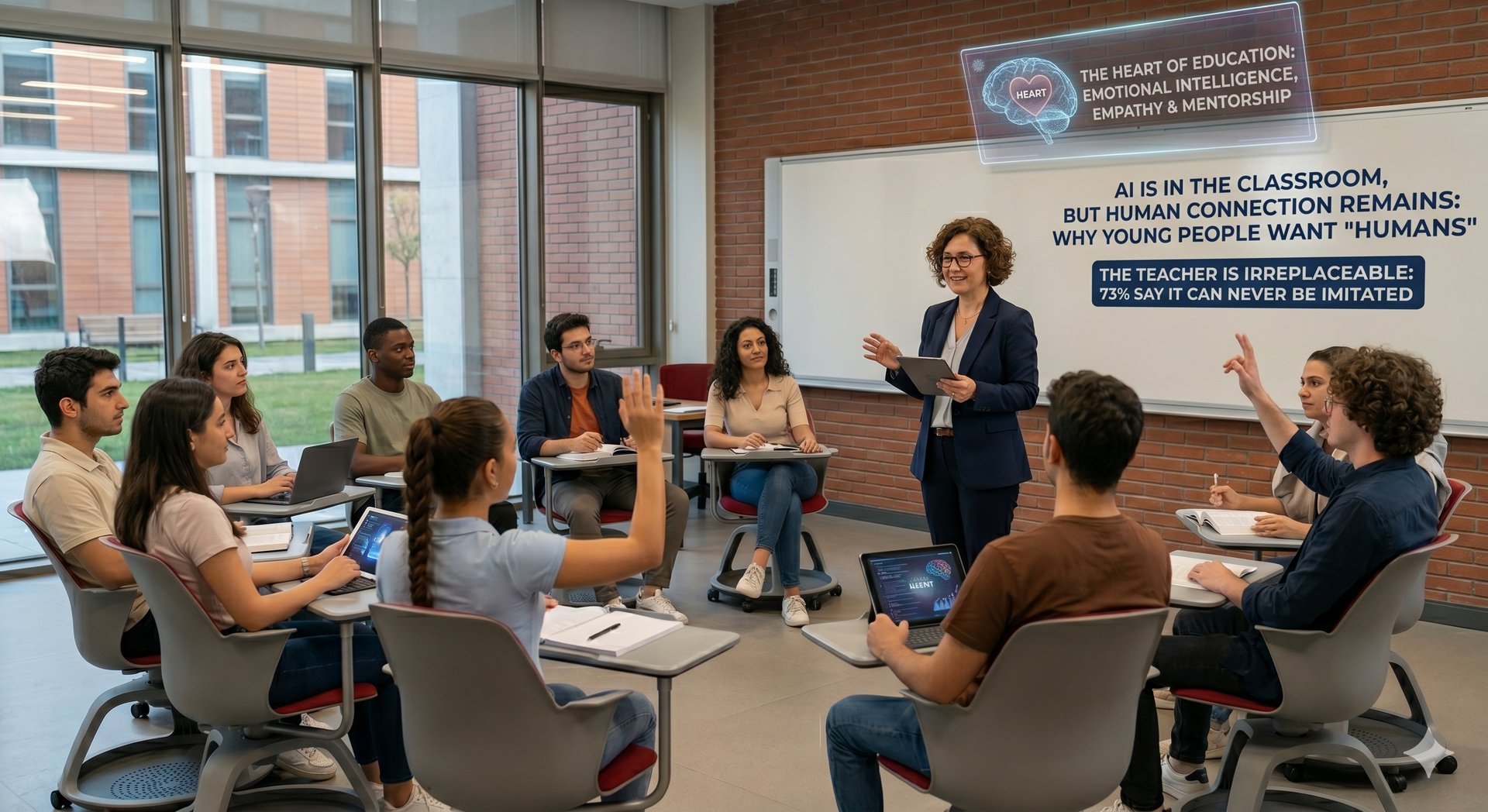
73% of surveyed students believe that teachers possess unique skills and qualities that can never be emulated by AI technology.
This data sends a crystal-clear message. Even the generation that adapts most easily to screens, smart tablets, and instant-response chatbots knows very well that learning is about much more than just a "transfer of information." Young people appreciate the speed and efficiency of AI. However, when it comes to developing themselves, being understood, and finding meaning, they prefer looking into a teacher's eyes rather than staring at the cold screen of an algorithm.
So, what is that exact "thing" students are insistently looking for that AI cannot replicate, despite its massive processing power and millions of books worth of memory?
The Wall AI Cannot Cross: Emotional Intelligence and Empathy
Learning is not a mechanical process restricted to the left hemisphere of our brains where we simply stack and record data. Learning is built upon trust, human connection, curiosity, and, most importantly, emotional interaction. An AI model can explain a math formula to you perfectly, but it cannot spark the inner flame that makes you understand why you need to learn it in the first place.
Students highlighted specific human traits in the report that they can never find in AI:
1. Genuine Empathy (Eye Contact and Intuition)
When a student walks into a classroom with slumped shoulders, a human teacher notices within seconds that they are upset or not ready to learn that day. A teacher can put the curriculum aside for a moment and ask, "How are you today? Is everything okay?" AI cannot notice this unless you type "I am sad." Even if you do, its response will be a mechanical template drawn from a database, saying something rigid like, "I share your sadness." Students want someone across from them who genuinely feels them.
2. "Personability" and Warm Samplicity
What are our most memorable moments in education? A funny story our teacher told during a break, a joke they made, or an example they gave from their own student years while explaining a difficult topic. These human imperfections, warmth, and personability build a bridge between the student and the knowledge. The flawless, sterile language of AI is far from building this warm connection.
3. Flexibility and Pedagogical Intuition
A great teacher changes strategies the moment they see the classroom's energy drop. They might postpone a planned assignment, turn the lesson into a game, or place a current topic that interests the students at the center of the class. AI, on the other hand, operates purely on rules and prompts. It lacks the instantaneous intuitive flexibility and situational awareness that a human possesses.
Information is Everywhere, But Wisdom Belongs to the Teacher
In the pre-AI era, a teacher's greatest asset was "possessing knowledge" and bringing that information into the classroom. In a world where encyclopedias and libraries were limited, the teacher was the ultimate source of information. Today, information has been completely democratized. ChatGPT, Claude, or Google search engines place the world's largest library right into every student's pocket for free.
At this exact point, the role of the teacher evolves from being a "source of information" to becoming a "guide and mentor."
When young people ask AI a question, they can receive thousands of words in response. However, they often do not know which answer is accurate, which part is useful, or how to apply that information to their real lives. AI piles up data; the teacher teaches how to filter it, evaluate it through a critical lens, and transform it into meaningful value. This is a core reason why young people want a "human"—they know that authentic mentorship and guidance can only be provided by a human being.
AI is Here to Liberate Teachers, Not Eliminate Them
The perspective offered by the Oxford report provides a wonderful insight for us as educators. We do not need to fear AI or worry about whether our profession will disappear. On the contrary, AI can become our greatest assistant.
How? Think about the tasks that consume most of a teacher's time and energy: grading papers, writing the same feedback repeatedly, drafting lesson plans, and filling out administrative forms. AI can take over these routine, mechanical tasks in seconds.
When AI lifts these administrative burdens off our shoulders, teachers are left with something incredibly valuable: time and energy.
Instead of dealing with paperwork, a teacher can spend more time focusing on the student sitting quietly in the back row. Educators can dedicate far more time to in-class discussions, developing students' critical thinking skills, and building one-on-one human connections. AI should enter the classroom not to eliminate the teacher from the system, but to free them from administrative heavy lifting so they can truly focus on teaching.
Final Thoughts: The Future Classroom is Hybrid, The Future Heart is Human
AI has entered our classrooms, and it is here to stay. The future architecture of education definitely cannot be built by excluding this technology. However, as Oxford University Press’s 2026 report clearly reminds us, the soul, energy, and success of those classrooms will still be determined by humans.
No matter how flawless technology becomes, no line of code can ever replace a hand patting a student's shoulder, a voice saying, "I believe in you, you can do this," or the collective energy of laughing together in a classroom.
The successful educational model of the future will be a "hybrid" one—combining the processing power of AI with the heart and emotional intelligence of humans. In this model, teachers will never be figures replaced by robots; they will remain the most powerful leaders shaping students' lives with technology backing them up.
In the next part of our blog series, we will look at the other side of the coin. Since young people view AI as a learning partner and demand guidance, how ready are schools to meet this demand? See you in Part 3: "Has AI Guidance Failed in Schools? The Great Call from Students." Let's meet in the comments: What do you think is the single greatest human trait that AI can never replicate in a classroom?
❓ Frequently Asked Questions (FAQ)
1. According to the Oxford University Press June 2026 report, what do students expect from their teachers?
According to the report, 73% of students believe teachers have unique human skills that AI can never emulate. Young people do not just want teachers to transfer information; they expect them to provide empathy, warmth, emotional support, and one-on-one mentorship.
2. Can AI replace human teachers in education?
No, it cannot. While AI excels at data analytics, rapid information retrieval, and routine tasks, it is entirely inadequate when it comes to building human connections, showing empathy, applying emotional intelligence, utilizing pedagogical intuition, and adapting flexibly to real-time classroom dynamics. Because learning is an emotional process, the role of human teachers remains permanent.
3. How can AI assist teachers in the classroom?
AI can handle routine tasks such as generating lesson plan drafts, grading mechanical assignments, automating administrative reports, and producing personalized practice exercises. This minimizes teachers' administrative workloads, saving them valuable time to focus on their students and build human connections.
4. What is the evolving role of the teacher in the age of AI?
The teacher is no longer the sole source or deliverer of information. In the AI era, the teacher takes on the role of a pedagogical guide, mentor, and wise advisor who teaches students how to sift through, verify, and critically analyze data.
5. What does the most successful integration of AI look like in education?
The most successful model is a "hybrid" educational model that combines the speed and personalization power of AI with the emotional intelligence and human-centered pedagogy of the teacher. Technology should support the infrastructure, while the human teacher continues to drive the heart and management of the classroom.